

~ Celebrating Cultural Heritage, Family & History ~
By: J. Chevont’e Alexander
“For Africa to me… is more than a glamorous fact. It is a historical truth. No man can know where he is going unless he knows exactly where he has been and exactly how he arrived at his present place.”
Candles. Red. Black. And Green. Corn. Family. Seven principles. What do all of these things have in common? Kwanzaa.
Beginning the day after Christmas through New Year’s Day, the Kwanzaa celebration is an African-American and Pan-African holiday celebrating family, community and culture. Dr. Maulana Karenga created Kwanzaa in 1966. Dr. Karenga is professor and chair of Africana Studies at California State University. He proposed this holiday to give those of African descent a holiday to celebrate their own cultural heritage and the key values of family and community. It is now estimated that nearly 28 million people celebrate the festival in some way.
“I am planning to celebrate Kwanzaa, this year for the first time with my family because I want my children to learn about out heritage. It plants focus more on family values and togetherness and I believe that celebrating this African custom will not only culture my children but it will also help them learn from where our long lost mothers and fathers have come from.” comments Tina Johnson, mother of two who will be celebrating Kwanzaa for the first time this year.
Kwanzaa is a cultural holiday, not a religious one, so Africans of all religious faiths practice it. It is largely a private celebration observed by individuals, families and local communities. The name Kwanzaa is derived from the phrase “matunda ya kwanza” (mah-TOON-dah ya KWAHN-zah) which means “first fruits” in Swahili, a Pan-African language which is the most widely spoken African language. Kwanzaa builds on the five fundamental activities of Continental African “first fruit” celebrations: ingathering; reverence; commemoration; recommitment and celebration.
According to Dr. Maulana Karenga, creator of Kwanzaa, Kawaida philosophy is built around:
1) An ingathering of the people,
2) A reverence for the creator and creation as it applies to nature and humanity,
3) A commemoration of the past — history, heroes and heritage,
4) A commitment to our highest ideals, and
5) A celebration of the good.
“Our children need the sense of specialness that comes from participating in a known and loved ritual. They need the mastery of self-discipline that comes from order. They need the self-awareness that comes from a knowledge of their past. They need Kwanzaa as a tool for building their future and our own,” says Jessica Harris.
YOUTUBE VIDEO: A Brief History of Kwanzaa
The Principles of Kwanzaa
Umoja (Unity)
Kujichagulia (Self-Determination)
Ujima (Collective Work and Responsibility)
Ujamaa (Cooperative Economics)
Nia (Purpose)
Kuumba (Creativity)
Imani (Faith)
The Symbols of Kwanzaa
The main symbols of Kwanzaa are a mat, to put the things on needed for the celebration, the unity cup used to pour libations, a candle stick holding seven candles, the seven candles, ears of corn, the Kwanzaa flag and a poster depicting the seven principles of Kwanzaa. A libation is the name given to a ritual pouring of a drink as an offering to a god.
The Colors of Kwanzaa
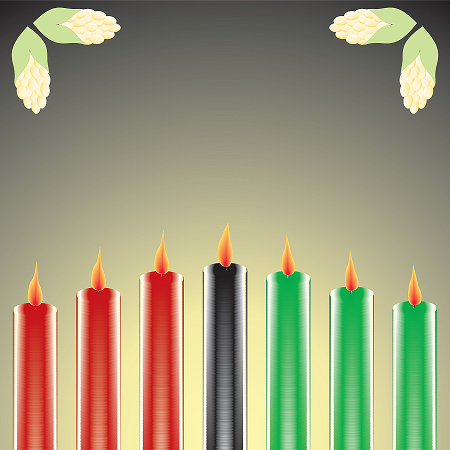
The colors of Kwanzaa are red, black and green. The Kwanzaa flag consists of three blocks, one in each of these colors. Three of the seven candles are red, three are green and one is black. Each candle represents one of the principles of Kwanzaa. The candleholder is carved from a single piece of wood and the form of the Ashanti royal throne inspired its shape.
A Kwanzaa ceremony often also includes performance of music and drumming, a reflection on the Pan-African colors of red, green and black and a discussion of some aspect of African history.
“I think Kwanzaa is important because it is more than an event. The concept of Kwanzaa is built on the seven principles of the Nguzo Saba, which if implemented consistently all year round will significantly improve conditions in the African American community. We should support events that promote Kwanzaa to further honor our cultural traditions and build community but most importantly we have to take into consideration that those seven principles should serve as agenda for our community everyday.” says Duron Chavis, organizer of Kwanzaa Kollective.
The Candle lighting Ceremony
The candle lighting ceremony, central to the celebration of Kwanzaa, takes place at a time when all members of the family are present. The ceremony begins with the tambiko (libation), an African form of praise that pays homage to personal and collective ancestors. To begin, the elder of the household pours wine, juice or distilled spirits from the kikombe cha umoja (unity cup) into the earth. While pouring, the elder makes a statement honoring departed family members for the inspiration and values they have left with descendants.
After the tambiko, as a gesture of unity, the elder drinks from the kikombe cha umoja and then passes it for all to share. The elder leads the call, “Harambee” (Let’s pull together), and everyone participates in repeating the phrase seven times. Candle lighting, central to the ceremony, reinforces the meaning of the principles. The placement of the mishumaa saba (candles) in the kinara is as follows: Black, for the color of African peoples everywhere, is located in the center. Three red candles, represents the blood of the ancestors, are placed to the left. Three green candles that symbolize the earth, life, and the ideas and promise of the future, are placed to the right. Beginning December 26 with the black mushumaa, a different candle is lit for each day, alternating from left to right. After the candle lighting, the principle of the day is discussed. The evening of December 31 (Day 6) is the karamu, a joyous celebration with food, drink, dance, and music for the collective family and friends. It is a time of rejoicing, reassessment and recommitment. The zawadi, handmade or similarly meaningful gifts for children, may be opened at the karamu, or on the final day of Kwanzaa, when the seventh principle, Imani is observed.
“Kwanzaa gave me the best sense of culture, family and faith that a holiday could give. The holiday was never about gifts, we mostly received books or something empowering, I loved it.” comments Tylen Hazard whose family celebrated Kwanzaa when he was a child.
Upcoming Kwanzaa Events in the Area
Janine Yvette Bell, the founder and artistic director of the Elegba Folklore Society,
Inc. and the festival’s coordinator, has produced annual Kwanzaa programs in Richmond
since 1986. The Capital City Kwanzaa Festival was first presented in 1990. Because of this programming, observance of the Kwanzaa holiday has consistently increased in Richmond and surrounding areas. The festival provides a particular contemporary significance against the backdrop of Richmond’s history. Richmond, the second largest slave market, is known as the capitol of the Confederacy and the “birthplace of black entrepreneurship.” The recognition of Kwanzaa and the embracing of its concepts is evident not only in the festival’s attendance, but also in the volume of requests for information and assistance from schools, churches and community groups.
Capital City Kwanzaa Festival (presented by Elegba Folklore Society, Inc.
Richmond’s Cultural Ambassador)
The Showplace Exhibition Center
3000 Mechanicsville Turnpike
Saturday, December 29, 2012
1 p.m. – 9 p.m.
$6 In Advance for General Admission $7, Door.
$5 Students (12-18) & Seniors (65+), Advance. $6, Door.
$5 Group Rates, 10 or More, Advance, Only.
Free for Children Under 12
8th Annual Community Kwanzaa African Heritage Celebration
Friday, December 28, 2012
Powhatan Hill Community Center
4 p.m.
For more information please visit: http://kwanzaakollective.org/.
Hull Street Library, Kwanzaa Story Time
Thursday, December 27, 2012
10 a.m.
Come and join Hull Street Library for a special story time about Kwanzaa. Preschool children are invited to attend. For more information please call 804-646-8699.
