

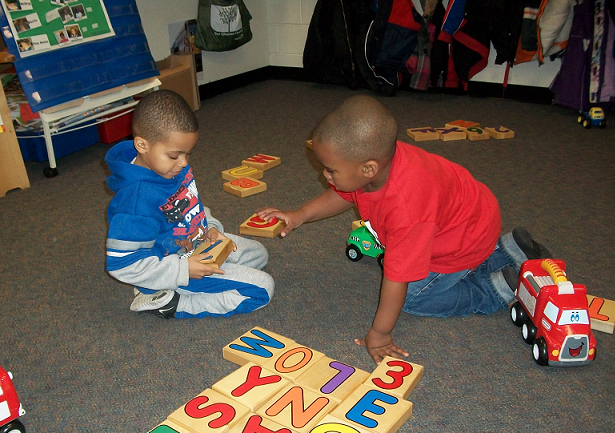
Boys playing with blocks and trucks. Alexavier (left) and Jason (right).
By Chevont’e Alexander
The Annie E. Casey Foundation reports that children from families with limited income start school with dramatically limited vocabularies, undermining their chance for success in school. The Foundation has also published widely praised research on the importance of starting a child on the path to success at a very early age. The human brain develops most rapidly before the age of 5, and in these early years of development the physical elements that grow in the brain create the framework for the child’s future ability to understand and remember, to solve problems and to express thoughts.
FRIENDS Childhood Development Program serves approximately 850 children a year, ages 6 weeks to 5 years. The children experience the Creative Curriculum, a nationally recognized system for early learning. They have overlaid that system with their unique, fully integrated health education and music and performing arts curriculum. For example, if the theme of the week is the natural world, the children may hear stories about forests, sing songs about bugs, color pictures of vegetables, harvest lettuce from their edible garden, learn the American Sign Language sign for the sun and the Spanish word for the sky.
The Youth Development Program serves approximately 70 boys and girls ages 6 to 19 from Gilpin Court, with mentoring, organized activities, field trips, homework supervision, scouting, music and performing arts, health education, and the special SOHO program for teen girls, a collaboration with the Richmond Redevelopment Housing Authority, the Visual Arts Center, and Art 180. All of the children learn math, science, and social studies, fully integrated into age-appropriate curricula.
“The Gilpin Court facility is so special because it truly is a gem. All of the neighbors, families, and children know who we are and what we do, and support and encourage our mission,” comments Peters.
The Family Development Program is staffed by social workers that identify issues with children or families and help them get the services they need to succeed. One key difference with FRIENDS is that these social workers hold the family and children accountable for attending the centers, receiving help, and doing the best they can to succeed in life.
The Summer Program serves children with age-appropriate physical activities, field trips, literacy enhancement, arts and crafts, constructive play, and healthy meals and snacks.
WHY EVERYONE NEEDS FRIENDS
FRIENDS core service programs are designed to assist family members to improve literacy skills, develop positive personal, social and self development skills and gain a broader understanding of themselves, their community and the world in which they live.
In addition, two support programs are also provided: Music and Performing Arts – offers children, youth and adults creative learning opportunity through the performing arts and, Health Education – teaches children and parents the value and importance of good nutrition, physical activity, and health and wellness practices.
CULTIVATING A VILLAGE
The Youth Development Program provides after-school educational and enrichment opportunities to supplement academic and social skills for at-risk youth living in the Gilpin Court Community.
“The hopes and dreams of these youngsters are shaped by television, popular music and the struggles of adults and parents in their homes, neighborhoods and schools. They simply are not exposed to what else life has to offer because they seldom travel, mix with aspiring youngsters their age or have the guidance and encouragement to learn about other cultures and nationalities. They simply do not know what is possible for them,” comments Cherry Peters, Executive Director of FRIENDS Association for Children.
The Youth Development Program is a year-round program for children who participate in the school age, teen and Youth Enrichment Program. The purpose of the Youth Readiness Program is to promote social, emotional, cognitive, and behavior competence to help children improve academic performance, school attendance, self-esteem, social behaviors, and to graduate high school with direction and goals for a productive future. It is designed to help children discover their potential and to maximize their skills, talent and capacity. These goals and objectives are based on best practices from Positive Youth Development research.
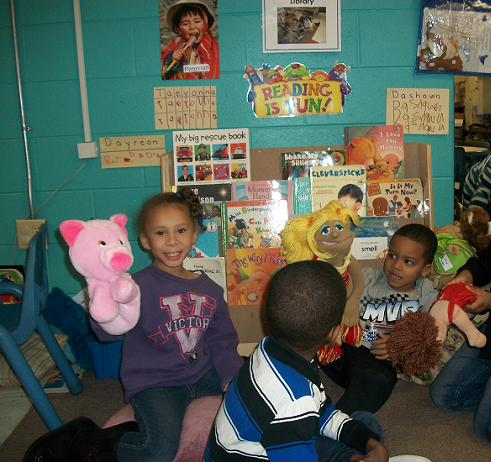
Children playing puppet show. Miracle (left), Quawi (center) and Alexavier (right).
THE YOUTH DEVELOPMENT PROGRAM IMPACTS YOUNG TEENS THROUGH THESE FOCUS AREAS:
Academic: The after-school tutoring program utilizes volunteers, college students and staff to assist participants with completing their homework. Participants use laptop computers to complete homework, participate in learning games, and take practice SOL tests.
Social & Enrichment: At the close of tutorial sessions each day, participants are provided a variety of social and enrichment opportunities. These include scouting, drumming, African Dance, anger management groups, reading groups, art, music and life skills sessions.
Music Education & Performing Arts: The music education and performing arts program began in February 2007. It offers youth opportunities for participation in weekly music education sessions in hand bell choirs, drama groups, singing choirs, dance troupes and private music instruction. One hundred twenty five students are selected to receive private music lessons, where they can take their instrument home
Scientific research shows that learning music helps develop the part of the brain responsible for math skills, and singing and learning how to read music supports literacy learning.
Health Education: The Health Education Coordinator provides weekly lessons that address topics critical to the development of young teens, including nutrition, physical activity, disease prevention and personal safety.
CHILD DEVELOPMENT
The objective of the Child Development Program is to properly prepare children to enter kindergarten and partner with public school personnel to increase and sustain the grade appropriate literacy ability children have when they enter school.
Because children are increasingly at risk for a variety of health problems and childhood obesity continues to be a growing problem in the United States, a Health Education component is an important addition to the academic and social skills development. Children from low income households are more than twice as likely to be obese when compared to children from higher income households.
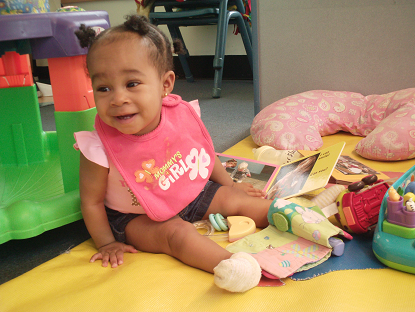
Infant (Aiden) playing with books.
COMMUNITY PARTNERSHIPS
Capital One’s Human Resources team decided to further expand the edible garden and, in May of 2011, brought over 70 volunteers to remove existing shrubs and to plant a variety of fruit trees, berry plants, herbs, vegetables and other edible items. FRIENDS is continuing to seek out partnerships and resources to complete the playground plan and Nina is working on plans for the other two FRIENDS centers.
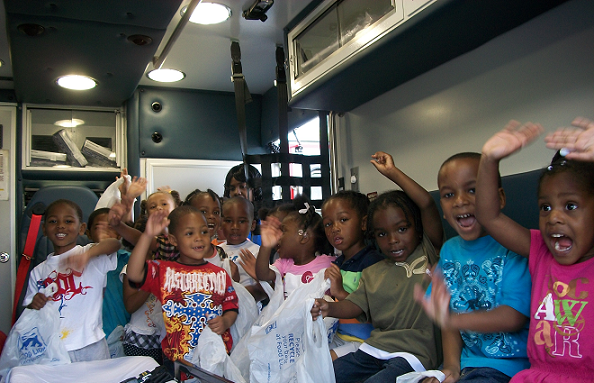
Mrs. Crafton’s class field trip to Health and Safety Day at the Children’s Museum.
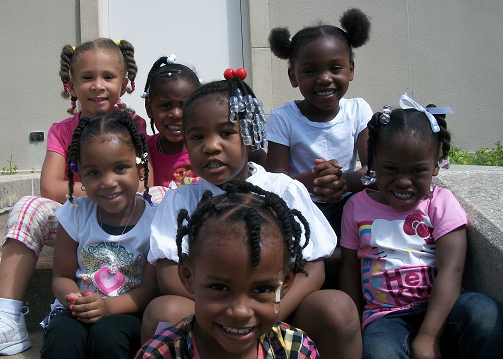
Fire Safety Day at the Children's Hospital on Brook Rd.
