
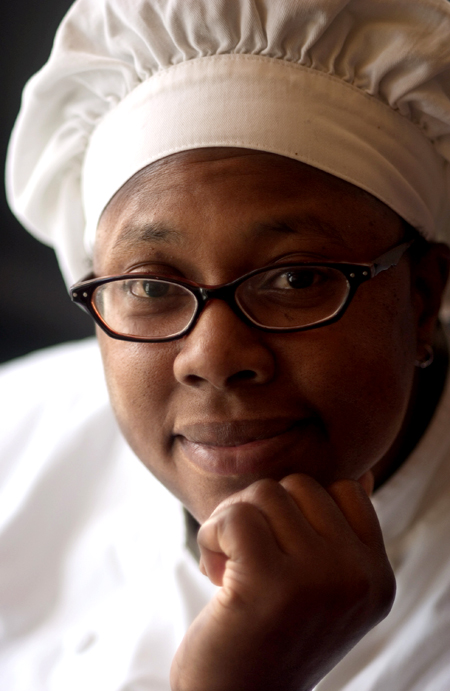
When her hugely successful Washington D.C. restaurant Colorado Kitchen lost its lease this summer and suddenly closed its doors, Chef and Owner Gillian Clark might have been nervous in transition. Then again, that’s one place Gillian Clark thrives.
Before she was being hailed in Food and Wine Magazine, the Washington Post, and on NPR, she was an ambitious Marketing executive. “I used to just cook for fun,” she remembers. But after several years, she says, “I got really burned out in Marketing and I decided to go to cooking school.” She enrolled at L’Academie de Cuisine of Gaithersburg, Maryland.
“Because I’d been an executive, I didn’t want to start at the bottom. A lot of it was I didn’t think I had the physique or the stamina. I also thought it was such a male-dominated industry.” After graduation, she expected to work in a support position and admits, “I thought that I would make product for Chef.”
In an effort to learn all she could about the business, she stepped behind the line. “I just got hooked. I ended up loving the intensity, loving the immediate results,” she remembers. She enjoyed what she admits was “a meteoric rise” and was soon leading kitchens as Chef, and not long after, as Owner.
“I use food to communicate, to tell a story,” she says. “I think of my restaurants as a book.” In fact, Clark is the author of Out of the Frying Pan (Thomas Dunn Books), a memoir that documents her life as she worked to launch a new career while raising two daughters and enduring divorce.
Along the way, she has refused to let her gender be an obstacle. “There are a lot of men that are in kitchens and in authoritative positions that don’t see gender or race, but then there are a lot who do. But I’ve been a black woman for 45 years. I know how to work it. I know how to not let it be in my way. It can be in your way or it doesn’t have to be. Talent wills out. If you can put up plates of food, you will work. You will always face, however, someone looking you up and down and not believing you can do it. I was lucky enough that my first cooking jobs, I worked for women chefs. That helped a great deal because they never thought I couldn’t do this job.”
“You’ve got to say no a lot,” Clark says. “A lot of owners don’t want to hear that from a woman, let alone a black woman. To a large extent you don’t find a lot of black women in this business and hopefully that’s changing. This is a profession that women of my generation, our mothers didn’t want us cooking. I’m doing a job that black women did after Reconstruction to pay the bills. For me to go to college and wind up here, I think there’s a lot of prejudice surrounding that; that I do this job because it’s all I can do.” That kind of blinkered thinking is why Clark believes, “I think a lot of chefs love the freedom of having their own restaurant.”
In 2001, she opened Colorado Kitchen, and diners embraced its simple and fresh menu.
“Colorado Kitchen was a great introduction for all of us in terms of getting people to see what we could do, the food that I could do and the fact that we could do a really great product that we thought originally would be a really great neighborhood restaurant, and became something bigger. A lot of people are anxious to have that kind of thing in their own neighborhood; something that is a neighborhood space and they’re welcome and familiar and everybody knows them, but also something that attracts people to the neighborhood.”
Last June, Colorado Kitchen closed when its lease ran out and the owners razed the building. Its disappearance unsettled staff as well as its many loyal patrons. “Believe it or not, people still send me emails asking when I’m going to have their favorite thing on the menu, and I have to tell them.” Thankfully, Clark has two restaurants in the works – Avenue Oven and The General Store. “That will be the closest thing to the Colorado Kitchen – country home style, back to basics.”
Avenue Oven will be in Tacoma Park and focus on a type of cuisine that Clark says doesn’t often get its due. “The food will be American but have an Eastern European influence to it. I’ve always been sort of fascinated at the notion of American food through the eyes of immigrants. I’m taking it from a New Yorker’s point of view as if they were Eastern European landing in Ellis Island.” Plans include pickles made in-house, blintzes, and “really good pastrami,” Chef Clark says.
She’s found that her past career has served this one. “I don’t regret having done that for 11 years. As I go on into having more restaurants, it will be an important part of how I do business.”
While Clark can remember several instances of tough treatment and blatant favoritism when she was an up-and-coming chef, ultimately, she sees a broad future for women in the industry.
“That’s the kind of attitude that’s just going to have to die if you’re concerned about your kitchen.”
