
What goes into the making of an American Dream?
There are as many methods as there are makers, of course, but also a few constants: a quest driven by curiosity; opportunity often bestowed by an honored guide who’s already navigated his dream’s terrain. Hopefully, there’s triumph, because obstacles to dreams are inevitable.
For Dr. Lauranett Lee, Curator of African American History at the Virginia Historical Society and author of Making the American Dream Work (Morgan James Publishing), one of her dreams may have stalled when she was ten years old. When Lauranett began the fourth grade, she entered a new school in Midlothian. “It was called ‘the white school’ at that time, because it was still during segregation,” Dr. Lee remembers. “I took Virginia History, and that’s when I found out that there were slaves, and that was the group I would have most likely have been part of. Until that time, I thought I’d be wearing those big hoop skirts and drinking tea. So it was really a shock to me, and I just lost all interest in history after that.”
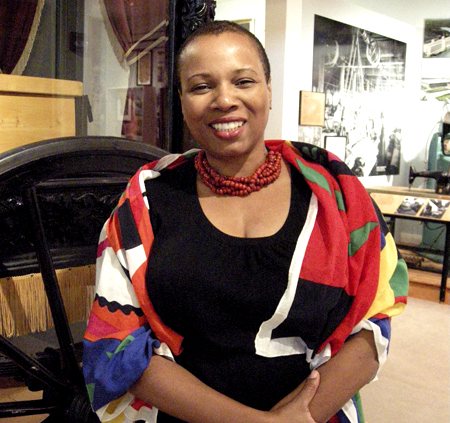
Making the American Dream Work chronicles the aspirations and obstacles of African Americans in Hopewell, Virginia. Its title could describe the process of its creation, and the life of the man who initiated it, the late Dr. Edgar Allan Toppin.
But as is often a tendency in dreams, we’re getting ahead of ourselves.
Lauranett Lee is originally from Chesterfield, the daughter of Clarence and Gloria. She has two brothers and two sisters. Dr. Lee admits, “I’m the oldest, so I had to be the leader, the responsible one. I don’t know if that always worked out,” she laughs, “but that was my parents’ goal.” She describes a comfortable upbringing, and a school life that was unremarkable, yet enjoyable. As she neared high school graduation, she says, “It was my duty to go to college. In a way, I really did not want to. I knew it was what I was supposed to do. I wanted to get away from home, so I thought, ‘Here’s my escape.’”
She headed to Shaw University in North Carolina. Although she finished her first year there, the school wasn’t an ideal fit. “I knew I needed an environment that was really going to be focused on my education, and not so big that you get lost.” She was dating a young man from Chicago, so she moved north and enrolled at Mundelein College, a woman’s college that has since become part of Loyola University. “It was a good choice; not only Chicago, but Mundelein,” she says. She earned a degree in Communications.
In 1990, Lee attended a Richmond area lecture during Black History Month. The speaker was Dr. Edgar Allan Toppin, the first black Board Member at the Historical Society, a world-class scholar and authority on African American History, and Dean of the Graduate School at Virginia State University. Lee remembers, “It changed my whole world, just completely changed me. He talked about history from the people’s perspective. He really made you understand how ordinary people can play a part in history. That’s not the way history had been taught at all. I began to see that there was a way to delve into history from another perspective that would be of greater interest to people, not just talking about the leaders and focusing on dates and that kind of thing.”
It was enough to overcome Lee’s indifference to History. “I made the decision then to go to graduate school,” she says.
Dr. Toppin’s life can stand as a testament to the transformative power of a dream and the quest for knowledge. Beginning in poverty during the Great Depression in tenement housing, Edgar Toppin would earn scholarships to the most prestigious institutions of higher learning, and eventually teach at Virginia State for more than forty years. With Dr. Toppin as her advisor, Lee researched Richmond women living in the early 20th century. During this time, she became the first “minority intern” at the Virginia Historical Society in a program funded by Philip Morris. After earning her Master’s degree, she went to University of Virginia, where she studied with Dr. Ed Ayers, President of the University of Richmond. “Ed Ayers really talked about ordinary people and how they can really impact history,” she remembers.
In researching a Massachusetts woman who moved to Charlottesville during Reconstruction to teach recently emancipated slaves, Dr. Lee worked directly with the manuscript of the woman’s memoir, and researched into the records of Charlottesville. “I began to see really how important education was. You hear people talk about education and that’s part of the American Dream. [When] you really start looking at the history behind it, particularly for women, and then when you add race on top of that, you begin to see that education is a way to propel yourself up out of the morass of life and to really begin to make an impact in the world, make a change in some way.”
She taught American and Women’s History at Old Dominion University in Norfolk. “It was absolutely wonderful; a multi-cultural environment, very forward-thinking. I didn’t know at that time how much I would love teaching history. One of the best ways to learn history is to teach it.”
But the ambition of finishing her Ph.D. wouldn’t leave her. Then the Historical Society offered her a position as Founding Curator of African American History. “I really had to struggle with that, because I love teaching. But then I saw this as an opportunity to reach out to a broader audience, and to learn something new.” She accepted the position, and in 2001, she says, “I came home and wrote.” Dr. Toppin was researching for a book he planned about African Americans in Hopewell. “I had planned to assist him on the book,” Dr. Lee says. But Dr. Toppin’s health was deteriorating.
“As he was getting sicker, he realized that he wasn’t going to make it, and I began to see it too. When he started talking to me about taking over the project, I was really ambivalent. It meant that my mentor was leaving this world. Then the City Council asked if I would take it over and I realized that this was something I really wanted, something that I had worked for. But it’s been really difficult in a lot of ways because I haven’t had his ear.”
Dr. Toppin died in 2004. For the next four years, Dr. Lee worked on the manuscript, which she eventually titled, Making the American Dream Work.
“One of the reasons I chose that title, is because in that city, which is very small, I saw that this is a place that was created to be all that Americans think the American Dream should be: home ownership, education, decent employment. At one time, people were coming from all over the world to work in this factory town. Yet you had this small group of disenfranchised, discriminated people who were still pushing to make that American Dream work for them. So I interviewed people and I looked at the historical sites to show how African Americans were part of those sites as well.”
“Actually, this is the making of the American Dream for me as well because this was a project that I just really wanted to do. I got advanced education in oral history. It’s working on it at night, on weekends. It’s always thinking about it, and knowing that in the end, it’s going to be out there for the world. The history profession is – we really critique each other, we pick each other apart. But then there just came a point, I said, I’m telling the story of these people in Hopewell. Just do it, and let it go.”
Making the American Dream Work is available at the Visitor’s Center in Hopewell, and online. Since reaching the goal she and Dr. Toppin envisioned for so long, Dr. Lee says, “I feel like I’ve really stepped into a different space. People ask all the time what’s next. I’m not really thinking so much what’s the next thing, I’m kind of enjoying this moment. We’re so geared to go, go, go and I don’t know if that’s healthy at all.”
Free time is still a new experience for her. She enjoys her three nephews and niece, and says, “I love being an aunt. On the weekends they come over and we watch movies and play video stuff and eat popcorn and stay up late.” She enjoying water fitness and dancing, and she dotes on her three year old English Spot rabbit. “I cannot believe how I spoil a bunny rabbit. She has her own room. She has an organic baby blanket,” Dr. Lee laughs.
Never finished with learning, Dr. Lee says, “I’ve been toying with the idea of taking a creative writing class. I think you can learn in many different ways. It doesn’t have to be college. But I think college gives you the opportunity to interact with people from different backgrounds and to test out your ideas and to really articulate what you’re thinking. I really think college is just the bee’s knees. But it’s not for everybody. But education is for everyone, for sure, if it’s trade school or an apprenticeship, an internship. There are opportunities to learn on different levels in different forms.”

1 comment
Splendid article!
Comments are closed.