

This year, about 380,000 babies will be born too soon and too many of them will not survive.
Infant mortality is one of the most important indicators of the health of a state, including a variety of factors such as maternal health, quality and access to medical care, socioeconomic conditions and public health practices.
“Infant mortality is the death of a live born infant prior to their first birthday (0-364 days old),” says Derek Chapman, Ph.D., Associate Director for Research for Virginia Commonwealth University’s Center on Society and Health, and Associate Professor in the Division of Epidemiology for the Department of Family Medicine and Population Health.
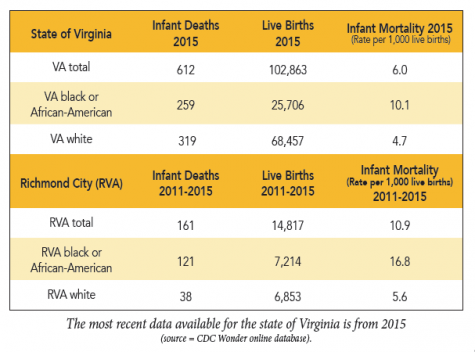
In 2015, the infant mortality rate in the United States was 5.9 deaths per 1,000 live births. Over 23,000 infants died in the United States in 2015. Nationally in 2015, the leading causes of infant deaths were:
- Birth defects.
- Preterm birth and low birth weight.
- Sudden infant death syndrome (SIDS)
- Maternal pregnancy complications.
- Injuries (e.g., suffocation).
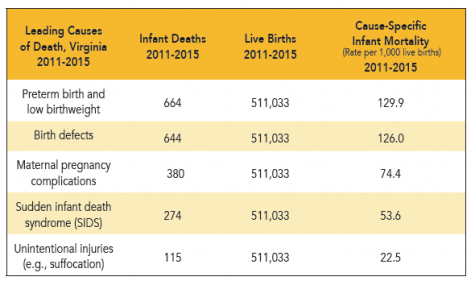
In Virginia (2011-2015 combined), the leading causes of death were:
According to the Virginia Department of Health, you can reduce the risk of sudden infant death syndrome (SIDS) and other sleep-related causes of infant death by creating a safe sleep environment for your baby. Did you know that the features of your baby’s sleep area can affect his/her risk for SIDS and other sleep-related causes of infant death, such as suffocation?
???SIDS is the sudden, unexplained death of an infant younger than 1 year of age that remains unexplained after a complete investigation. This investigation can include an autopsy, a review of the death scene, and complete family and medical histories.
A diagnosis of SIDS is made by collecting information, conducting scientific or forensic tests, and talking with parents, other caregivers, and health care providers. If, after this process is complete, there is still no identifiable cause of death, the infant’s death might be labeled as SIDS.
How can you make a safe sleep environment?
- Always place baby on his or her back to sleep for all sleep times, including naps.
- Have the baby share your room, not your bed. Your baby should not sleep in an adult bed, on a couch, or on a chair alone, with you, or with anyone else. Try room sharing—keeping baby’s sleep area in the same room next to where you sleep.
- Use a firm sleep surface, such as a mattress in a safety-approved crib, covered by a fitted sheet.
- Keep soft objects, toys, pillows, crib bumpers, and loose bedding out of your baby’s sleep area.
- Dress your baby in no more than one layer of clothing more than an adult would wear to be comfortable, and leave the blanket out of the crib. A one-piece sleeper or wearable blanket can be used for sleep clothing. Keep the room at a temperature that is comfortable for an adult.
- Safety-approved portable play yards can also provide a safe sleep environment for your baby. When using a portable play yard, always place baby to sleep on his or her back and keep toys, pillows, and blankets out of the play yard. These actions help reduce the risk of SIDS and other sleep-related causes of infant death.
Despite the existence of compelling research and statistics about the importance of safe sleep in reducing our nation’s high rate of infant mortality, the number of babies who die in adult beds and other unsafe sleep environments is on the rise. In fact, of the more than 4,500 sudden, unexpected infant deaths each year, statistics show that as many as 80-90 percent are the result of unsafe sleep practices. These are preventable deaths.
