
 In 2013, the Central Virginia African American Chamber of Commerce (CVAACC) joined the ranks of chambers whose mission is to foster support amongst local businesses. What made the CVAACC unique however, is their special focus on Black businesses which hold the key to job creation and wealth circulation within the Black community. In the years that followed, the chamber grew at a rapid pace, with over 150 sole proprietors, small businesses, and corporations all collaborating to grow the network of Black-owned businesses operating in Central Virginia. As the chamber expanded, so did the need for fresh ideas and innovation. Ervin Clarke, Founder and Chairman of CVAACC, began his quest to recruit new faces to its Board of Directors, and together, they put in place strategy to better serve its members and the community. This quest also called for a new Executive Director.
“This job was made for me.”

Micah White
Not even five minutes into the pitch to Micah White, known to many as Comedian Micah “Bam-Bamm” White, he interjected with the utmost confidence that he was the man for the job. And he was right; to many, he’s a comedian who’s spent the past 21 years using comedy to find common ground between race, religion, and socioeconomic status. But if you know him off the stage, you’ll know that his community initiatives align perfectly with the chamber’s longstanding mission to uplift the Black community through job creation and entrepreneurial training, among other things. He’s hailed as the ultimate communicator, bridging gaps between low-income communities and corporations through his jail program, and has opened the door for unlikely collaborations between artists and non-profits through his company, RVA Has Talent.
For White, his new role as Executive Director isn’t a career change, but rather a conduit through which he may continue his existing initiatives. What exists now is a perfect marriage of White’s vision and passion with CVAACC’s mission and platform, all of which will serve Black businesses and ultimately, the Black community at large.
“My goal is to help build businesses,” he explains on his way to practice. In addition to the many hats he wears in the community, White is also the Head Girls’ Volleyball coach at James River High School. “And it’s not just for the business, but for the overall movement. We run businesses as if we’re in competition with everybody, but the reality is that the African American community needs to join together; it will make us much more powerful.”
White believes it’s this mentality that has kept Black businesses—and the community—stagnant for so long. He looks to other cultures who band together and keep money within the community; when they come to the table, they’re coming with something in their hands. It’s time for the Black community to do the same.
This type of togetherness is what he fosters with his company RVA Has Talent, which creates unlikely pairs between local artists and non-profits to help raise money and awareness. Through the collaborations, country artists may find common ground with R&B artists and create opportunities to perform together. Hip-hop artists learn about unique non-profits and build relationships so that they can continue lending a helping hand. Different entities come together to create a larger society, which is the exact formula White plans to implement within the chamber using existing resources like the Member Directory and monthly networking events.

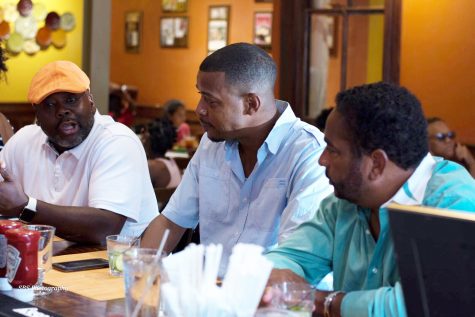
Always a familiar face, Micah shares laughs with patrons at his favorite restaurant, Mama J’s.
 Call it coincidence, serendipity, or fate, but every initiative White has begun since his unexpected move back to Richmond in 2012 all points to and aligns with CVAACC. Even his jail program, sparked by an impromptu meeting with Haley Buick GMC’s Barry Moore—an initial investor in RVA Has Talent—lays the foundation for the entrepreneurial training the chamber will add as a core component for its members. In fact, that’s what made White an attractive candidate during the hiring process. Discussions swirled amongst the board on how its members could pay it forward and mentor students and aspiring entrepreneurs. To take it a step further, CVAACC plans to implement an internship program allowing members to receive help while simultaneously exposing the community to various career fields.
White’s jail program does just that, and more.
“I entered the jail as a speaker, but knew that in order to affect change, it’d have to be a long-term effort,” White recalls. “So I started a program with the help of Dr. Sarah Scarborough, Richmond City Justice Center’s Internal Programs Director. The program teaches jail residents to write résumés and cover letters, fill out job applications, and learn interview skills.”
Studies show that in order to live independently of government assistance, the average Richmond resident needs to earn a yearly salary of just $30,000. White partnered with local corporations to not only conduct mock-interviews with residents, but to also foster connections between those businesses so that they may become gainfully employed upon release.
The program has gained support from Mayor Levar Stoney, Sheriff C.T. Woody, and many other community leaders who have a vested interest in building better citizens who contribute to the city’s economy. And while the chamber doesn’t deal directly with jail residents, its members will have the support needed to employ and mentor those re-entering the workforce. Providing that support is top priority for White as Executive Director.
“I want to position businesses to become mentors to the community by turning giving into commerce,” he says proudly. His plan is to develop a system of sorts that allows members who give back through mentorship or employment to gain points that can be used within the chamber and between businesses.
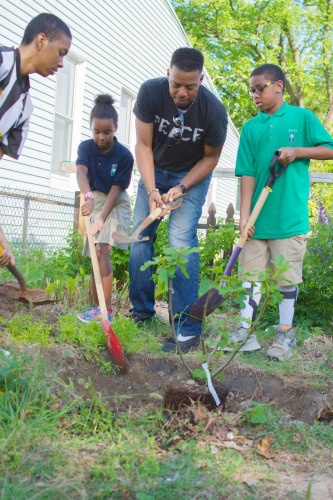
Micah and students of Peter Paul Development Center plant a tree for Earth Day 2017.
This is but just one idea White tosses out during a 30-minute phone call. His enthusiasm for CVAACC and its potential is evident, and he believes there’s no better time than the present for businesses to jump on board. The chamber, he believes, is critical to the development of the Black community and its self-sufficiency, and with the proper leadership in place, opportunities are endless.
“Every new business undergoes a shift, a process, and a learning curve before it has an exploding impact,” White explains. “The chamber is now coming out the curve strong, and we’re ready to hit the ground running. With my mindset and ideas combined with the chamber’s foundation and direction, this shift has already begun.”

As White begins meeting with constituents who will make up CVAACC’s Leadership Foundation—a collective of large donors and sponsors whose monetary contributions and counsel helps the chamber meet its goals—he realizes the importance of collaboration between all businesses, not just Black-owned.
“The chamber is very specific with who we’re trying to reach, but we’re all-inclusive. Can a white business join an African American chamber? Absolutely.”
Despite misconceptions about the purpose of Black organizations, the chamber’s mission is clear: to use resources, education, and relationships to strengthen the local Black community, which will ultimately strengthen the Richmond community as a whole. And it doesn’t begin and end with African Americans. When asked what a white company has to gain by joining and supporting the chamber, White recalls the importance of interracial collaboration during the Civil Rights Movement, and his answer is simple, yet poignant:
“Progress has never been made by one race and one race alone. We’re here to build Black business and put the dollar back in the community, but we need everybody during this process. And you will win. In the end, we’ll all win.”
