
By Janna M. Hall
“I have never been able to discover that there was anything disgraceful in being a colored man. But I have often found it inconvenient…in America.”
 The story of Egbert Williams and his rise to fame in the Vaudeville era is equally inspiring and heartbreaking. Inspiring, of course, because in the midst of ongoing racial discrimination, lack of representation, and limited options for entertainers of color, Williams managed to use his life-long knack for stealing the spotlight to solidify his place in the ever-growing industry. He, along with his partners George Walker and later Lottie Williams and Ada Overton, revolutionized what it meant to be a person of color on centerstage. Complex, dynamic, talented, and brilliant beings, black Americans’ rich history deserved to be told in an authentic manner, and Williams saw fit to shed light on those often glossed over aspects of the Negro.
Williams’ story becomes heartbreaking, however, when he decides that the only way to truly be seen on stage is to hide the very thing that makes him a dynamic character in the first place. Donning blackface in an effort to pacify whites during the blackface era, Williams sought to remain easily digestible to white audiences around the world. Maintaining his authenticity as a negro man while simultaneously neglecting his own skin served as Williams’ greatest feat, a constant internal struggle.
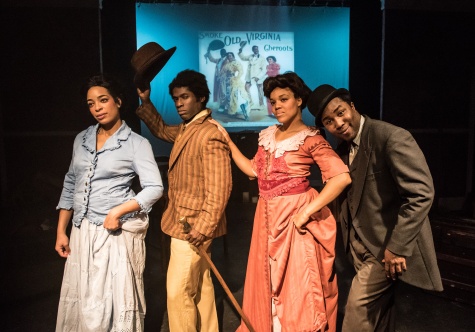 The Top of Bravery, written by Jeremy V. Morris, who also stars as the great Williams, and directed by Dr. Tawnya Pettiford-Wates, showcases the life and rise to fame of the man W.C. Fields describes as “…the funniest man I ever saw, and the saddest man I ever knew.”
The Quill Theater’s four-character production takes theatergoers through a captivating journey through Williams’ adolescence, the initial discovery of his raw talent, and rise to fame with his vibrant partner George Walker (played by Keydron Dunn). His connections to Richmond, Virginia, San Francisco, and New York City are laced throughout his story, but those connections pale in comparison to the devastatingly strong connection to entertainment industry racial tension in the early 19th and 21st centuries.
The Top of Bravery addresses deep-seated issues, such as white supremacy in the form of blackface—”white’s perception of superiority causes them to believe they can portray negroes better than negroes themselves”—and unfounded beliefs society has adopted about negroes post-slavery.
The most enchanting moments of the production are those times where the audience is forced to examine the ideals society holds about blacks in America. “How did slave-owners conclude that blacks were stupid, lazy, and happy to be enslaved?” Williams asks while emulating a lazy slave-owner sipping lemonade while his slaves work through whippings, sing hymns pleading for salvation, and reconstruct shoes that outsmart the masters as they make their escape.
 The Top of Bravery is a phenomenal production that serves as an educational tool for those who deny the struggles entertainers of color face in show business today. It further proves that hashtags like #OscarsSoWhite aren’t founded in some new sense of entitlement, but rather reflects a struggle that dates back to the Vaudeville era. Morris’ candid portrayal of Williams’ “7,000 foot trek” up a mountain aligns with the difficulties actors today face to remain authentically African American—with the complexities and brilliance they naturally possess—while remaining palatable to white audiences who have determined what it means to be black in America. Both Williams and Walker fought to create entertainment and be entertainers that discarded the imagined view of negroes.
“We shouldn’t have to chase the imagined. Whites should chase our authenticity,” he says.
With the help of Lottie Williams (Katrinah Carol Lewis) and Ada Overton (Jasmine Eileen Coles), Williams and Walker formed a quartet that created a platform for women of color. Their contributions took Williams and Walker to another groundbreaking level, and though the production focuses on Bert Williams’ life and journey in the Vaudeville era, Morris makes it clear that his success and impact on this world is in part due to his collaboration with other remarkable performers.
Appropriately named, The Top of Bravery ultimately highlights what W.E.B. DuBois believed Williams’ life represented. Navigating the internal struggles with performing in blackface, DuBois realized that his performances weren’t “more of the same.” He bravely addressed racial issues, kept people laughing, and ultimately, created an environment where whites and blacks could share the same spaces and energies and unite over one commonality—the appreciation of undeniable talent.
“[Bert Williams] has done more for our race than I have; he’s smiled his way into people’s hearts.” – Booker T. Washington
The Top of Bravery is currently showing until February 5th, 2017 at Richmond Triangle Players Theater – 1300 Altamont Avenue, Richmond, VA 23230.
Photos by Aaron Sutten.
