
By Dr. Hollee Freeman, Director, Math Science Innovation Center
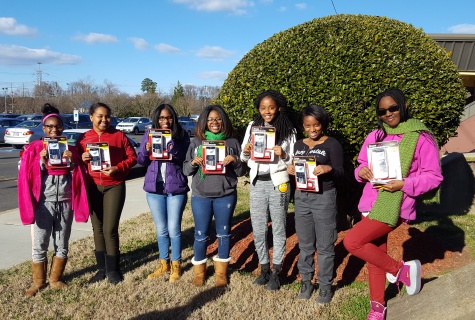
Fairfield Middle School students at Girls in Math Day at
MathScience Innovation Center show off calculators given by Capital One.
It seems as though we are on the cusp of another great space race. Countries are vying for rights to colonize Mars and are placing their bets on who will be the first to go there. South African-born engineer, inventor and founder of SpaceX Elon Musk and many others are using their considerable resources to change our very humanity. For these innovators, interplanetary life through a human colony on Mars is unavoidable and all but ensures that humans never face extinction.
This renewed interest in life outside of our planet is timely given the recent death of Astronaut, engineer and Statesman John Glenn, who was the first American to orbit the Earth, circling three times! Even more timely is the movie, Hidden Figures, where we will be able to not only relive amazing moments in space travel but also get a glimpse into the contribution that three African-American women played in the success of John Glenn’s mission. This one event, singlehandedly, boosted the morale of the United States, showed us as competent and qualified competitors in the great Space Race and brought the eyes of the world to our doorstep.
The lives of the women mathematicians working at NASA who made this and other space travel events possible–Katherine Johnson, Dorothy Vaughan and Mary Jackson–in many ways reflect the lives of our current female mathematical heroes, whether they work for NASA or for the Richmond Public School system.
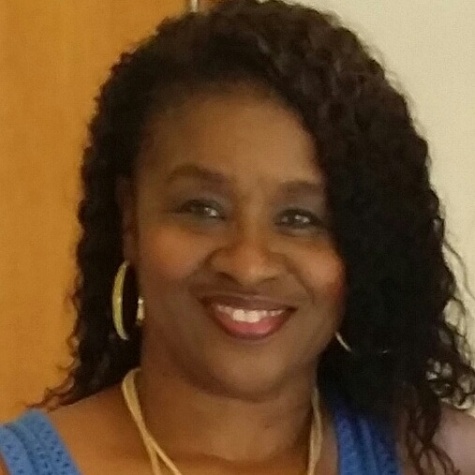
Shelia Scott
One such math hero is Shelia Scott. I met Principal Scott several years ago, before her retirement, when she was the Instructional Leader at Miles Jerome Jones Elementary School in the southside of Richmond City. Principal Scott invited me to serve as a member of her school’s Strategic Planning Team. During the Strategic Planning Team session, Principal Scott, who was highly regarded by her staff and colleagues, shared the story of how she came to love math. I knew instantly that I wanted to write about her story.
Many years later, I am able to tell a portion of the Principal Scott’s math story, in honor of her and the mathematicians that helped to send Astronaut John Glenn into space and the countless young mathematicians that we see in schools every day.
Freeman: Where did you get your love of math?
Scott: I grew up on a farm where my father was a sharecropper. I got my love of math from my father, who was a math wizard. He could figure out how many pounds of fertilizer per acre were needed for his crops without even using paper and pencil. Our success in school was very important to my parents. Every night after dinner, mom would have us all sitting around the dining room table to get our homework done or just to study. As we did our homework, my father would always make time to come to the table to give us his assistance with the math problems. He just had a knack for it.
Freeman: What is one of your earliest memories doing math?
Scott: When I was little, I can remember my father counting with us as we played games. We would skip count by all numbers just for fun as we worked in the fields on the farm.
My father would ask us simple things such as, “What makes 10?” He would go around the table and no one could repeat a fact combination. He would continue, “How many 6’s are in 12? What makes a dozen? How many ounces are in a pound? How many cookies do I need so all of you can get 2 a piece?” We would all try to be the one that could give the correct answer first. We laughed, gave high fives and cheered. It was so much fun and we always looked forward to this fun time together. Even after working hard on the farm all day, he made time for us during study time. We always wanted to make him proud and show him how well we could do math in our heads. With a 6th grade education, my father made math fun and we all learned to love it!
Freeman: When did you know that you loved math?
Scott: I knew early on that I loved math. I excelled in it all through school. I loved to figure things out differently. In grade school, I learned things by heart and not by using my fingers. I took great pride in using mental math all the time.
Freeman: Tell me about your work in Richmond Public Schools?
Scott: I came to RPS at the beginning of my fourth year of teaching by the way of an opening for a Title One (Chapter One at that time) Math Teacher position in 1978. My job was to work with the students who scored below 40th percentile on the state assessment. I taught math for 19 years. It was a pivotal time in education as changes were being made around the idea to teach mathematics. The new “hands-on” concept was right down my alley! Using some of my father’s techniques, I would ask my students, “What makes 8?” Then I would ask, “Okay, so what makes 100?” Kids started to enjoy the way that we did math. We made up chants, clapped beats for times tables, sang songs, and wrote about math. I accepted answers as long as the students could rationally explain how they came up with the answer. Those who were skeptical about their abilities in math, soon began to enjoy it.
Teaching math was my passion. Even before STEM (Science, Technology, Engineering, & Mathematics) was STEM, I was cooking in the classroom with my students. I even wrote a grant for the Virginia Department of Education to make math kits for the kids to take home so parents could do fun math activities with them at home. These activities came with a journal so that students and their families could write about what they were doing.
During this time, I also had a part-time job with the Adult Career Development Center. The ACDC needed a math teacher for the students who were trying to obtain their GED. I worked with them for several years at night. Since I had always worked with elementary children, this gave me an opportunity to impress upon older students the joy of becoming successful with math.
Freeman: What was your biggest joy as principal?
Scott: I was a principal for twelve years and every day, I loved going to classrooms and working alongside teachers, often sharing some of my little tricks of the trade to help the students understand a difficult math concept. This helped the teachers learn new concepts, as well as allow me to work with students. I conducted many in-house staff development trainings with teachers and I presented at many local, state and national math conferences. My main focus was mental math and hands-on learning. I related math to everyday situations and told the participants how important it is for them to see the importance of math in everything that they do. My former students continued to come back to the school years later to relate how much they enjoyed math.
Freeman: What are your tips for families?
Scott: It is important for families to instill a sense of joy of learning math skills at an early age. When you are going to the store, let the kids see you weighing the produce. Ask them how much does this cabbage cost per pound? Allow them to compare items to determine which item is lighter and which is heavier. Even before your children enter pre-school, have them sit in the kitchen with you while you are cooking. Do not tell your children that you are not good at math! Make learning what it should be for children: Exciting. Let them explore! It’s how you present the subject that really makes the difference. If you are excited, children will be excited as well.
—
As we celebrate the three brilliant mathematicians who helped get a person on the Moon, let’s also celebrate our local heroes as well. Thank you, Shelia Scott, for your inspiration. Who knows? The first person to inhabit Mars may be sitting in a classroom at Miles Jerome Jones Elementary School right now.
