
 Strength in Numbers
Using the Powerful Black Dollar to
Support Black Businesses
by Janna M. Hall
Throughout our history in America, symptoms Black Americans have internalized messages that affirm our significance and help us place value in ourselves in a time when America didn’t. “Black is beautiful, troche ” we’ve told our little black girls and boys. We’ve emphasized the beauty in our unique texture of hair, the deep melanin in our skin, and the curves in our bodies. “I’m Black and I’m proud,” shouted James Brown on stages across the world. His message instilled a sense of pride in an oppressed people and made them proud to be descendants of African royalty despite their tumultuous history in the U.S. “Black Lives Matter,” we chant in protest, demanding a stop to police brutality, a stop to the corrupt justice system, and the demonizing of those who fall victim to it. Such mantras have become staples in the black community, phrases we teach to our children as soon as they can begin comprehending who they are and how they’re different from white counterparts. But there’s another phrase that needs to be chanted until it’s internalized, and chanted until it becomes a way of life, just like the aforementioned mantras: “Support Black Business.”
In September 2015, Nielson, the top global marketing and media research firm, ran a consumer report on the increasing influence of African Americans in this country. “Increasingly Affluent, Educated and Diverse: African American Consumers”, the report said in its title, and it goes on to spell out the growing influence of African Americans in all aspects of American culture. The report examines a group composed of “trendsetters, education enthusiasts, media influencers, social activists, and content creators—all anchored by a strong cultural influence.” Their findings detail a narrative not often found in the mass media: there are many African American households not living below the poverty line, and those households have some serious buying power, power that is undoubtedly shifting the culture. And because the growing African American consumer base is comprised of the younger generation, they’re the tastemakers and trendsetters. Their dedication to social media allows the masses to see which brands they’re loyal to, which companies have excellent (or poor) customer service, and ultimately, which businesses others should and shouldn’t patronize. They truly define mainstream culture, and brands are taking notice—their marketing strategies are even tweaked to target their biggest non-white consumers.

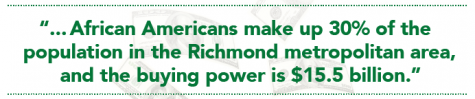
African Americans make up only approximately 13% of the nation’s population, but our buying power is projected to reach $1.2 trillion in 2016, a 275 percent increase from 1990, when buying power was $320 billion. The University of Georgia’s Selig Center for Economic Growth predicts that by 2020, that buying power will reach a whopping $1.4 trillion.
Why then, with such power and such influence, are black businesses opening and closing at such a rapid pace? Why do only 2 cents to every dollar go back into the African American community? Why are people more eager to spend hundreds at mall department stores, but won’t visit the local black-owned boutique? Vanessa Perry, Founder and CEO of Thyme Out, a Richmond-based personal services company that offers home cooking, cleaning, errand, and catering services, believes it’s because too many consumers value convenience over everything else.
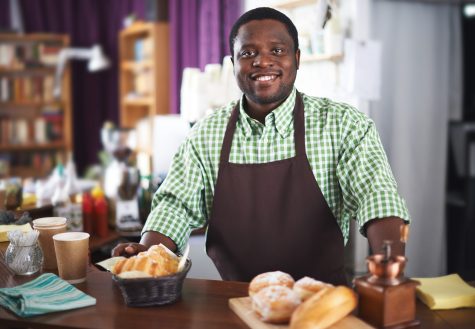
“The majority of consumers tend to go support people who are already established,” she says. “Sometimes it’s just more convenient for them. For example, ordering from ![[ File # csp6803376, License # 2676449 ] Licensed through http://www.canstockphoto.com in accordance with the End User License Agreement (http://www.canstockphoto.com/legal.php) (c) Can Stock Photo Inc. / Lvnel](https://dev.urbanviewsweekly.com/wp-content/uploads/2016/07/canstockphoto6803376-475x445.jpg) smaller businesses sometimes means shipping isn’t as fast as with larger, more established companies. But it’s so important to support local, black companies. Many of us have had to jump through more hoops to start our businesses than any other race, so we have to show the support that’ll keep those businesses thriving. We can’t value convenience and only shop at large companies and then wonder why that small shop down the street is closing down. It’s because it wasn’t supported.”
smaller businesses sometimes means shipping isn’t as fast as with larger, more established companies. But it’s so important to support local, black companies. Many of us have had to jump through more hoops to start our businesses than any other race, so we have to show the support that’ll keep those businesses thriving. We can’t value convenience and only shop at large companies and then wonder why that small shop down the street is closing down. It’s because it wasn’t supported.”
Supporting local business also keeps the city thriving. It puts money back into the local economy, empowers small business owners, and provides more opportunity for employment for the city’s residents. Supporting black local businesses holds a similar effect, yet is felt on a larger, more personal scale. It reduces black unemployment, which is alarmingly high in many inner cities, and creates a domino effect, inspiring other black entrepreneurs to set up shop within their own community.
Perry wholeheartedly believes that black-owned businesses provide opportunity where larger companies don’t. She recalls her good friend Tonya Thompson, a Richmond-based woman who had trouble staying employed due to her criminal record. “Every time [Thompson] got a new job, later down the road they’d have to let her go because of the felony on her record. Eventually, she took the steps to open her own cleaning business, Quality Cleaning, and she now employs people who are out of jail and looking for work. And that’s the great thing about black-owned businesses—they’re eager to pay it forward and help other people because of what they’ve been through to get there.”
Richmond and its surrounding counties are bustling with black-owned businesses, from accounting firms to construction companies, and from coffee shops to consignment shops. The Central Virginia African American Chamber of Commerce provides a directory for a majority of these black businesses, granting members of the community direct access to the owners and employees. It is through services like this that the Black dollar is able to circulate internally, which fosters business growth. In addition to growing, these businesses are able to pour into their communities by providing practical job skills to those entering the workforce, scholarships to recent graduates pursuing higher education, and the opportunity for Black employees to see themselves as the employer, not just the employee. Such examples are critical in building a strong infrastructure within the black community.

Even still, simply having the businesses up and successfully running isn’t what will build a strong infrastructure. More important to the cause is the amount of money put back into the businesses and the awareness brought to them. Black youth should remain dedicated to using their influence to shift awareness toward local black businesses, plugging their favorite local boutiques and restaurants as frequently as they plug the latest designer label. Creating the trend of buying locally also fosters relationships within the community and bridges the gaps that separate neighborhoods and the people in them. Yes, the “trendsetting” Black youth not only have the money and influence to shift mainstream culture, but they have the potential to build and foster positive relations between fellow black youth on a local level.
All in all, black businesses are more than just someone’s means to an end. They’re a manifestation of those mantras internalized by African Americans, mantras that reinforce Black value and beauty, both internally and externally. They’re a manifestation of mantras that our lives matter, that our intelligence and business savvy can impact the world, and that our resilient self-starters can defy odds and emerge as victorious entrepreneurs. It shouldn’t be about convenience, but about building a system that ensures that the strong Black dollar circulates internally and strengthens our communities. It’s about honoring small beginnings and patronizing local, black-owned businesses so that they may one day be the “convenient,” “more established” companies the masses so eagerly support. “Support Black Business” needs to be more than just a catchy phrase or the latest hashtag. It needs to be way of life.
