
Kim Farrar & Bloodline Shatter
Music Industry’s Glass Ceiling
by Janna M. Hall
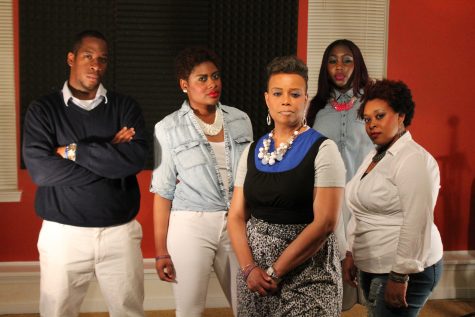
Dra’Von Adams, Ashley Farmer, K. Farrar, Tiana Seay, Jessica Bagby
Behind every successful musical artist, you’ll find an even more successful powerhouse team. On the creative side, that team includes writers and instrumentalists, vocal producers, engineers, and creative video directors. On the management side, you’ll find the artist’s manager, publicists, A&R, and at the very top, the executive. The making of a successful artist or group lies not just in the vocal talent and stage presence, but in these professionals who make sure the industry as a whole produces quality, popular music that keeps their pockets lined. A common critique of the music industry, though, is that while the face of many record labels is one of color, the business side is still, even after great social progress, a “white boy’s club” wrote Paul Resnikoff, publisher of Digital Music News.
Since the 1900s, African Americans’ musical talent has revolutionized entertainment across genres. The history of Blues, Hip Hop, Rock n’ Roll, and Pop—to name a few—can be traced back to urban artists with a sound that keeps their names etched in the musical history books. But if you read album credits, very rarely do you see their name occupying the behind-the-scenes roles. The disparity becomes even greater on the executive level, with white male execs dominating the field. This leaves very few spots for others, including white women and black men. And while African American males make up an even smaller percentage than white women, nearly nowhere to be found on the music exec totem pole is the black woman.
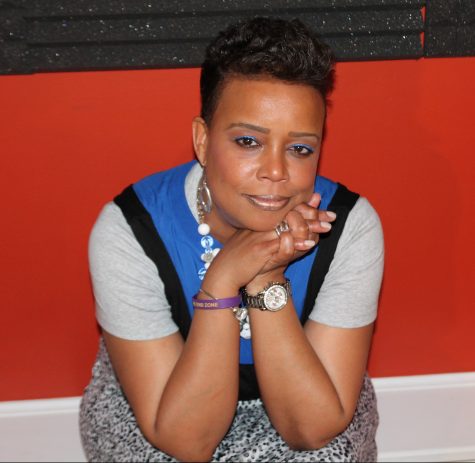
Kim Farrar
Knowing this, it’s no surprise that Kim Farrar wears her title as Founder, President, and CEO of Bloodline Music Group as a badge of honor. Where the woman is oftentimes the pretty face in a competitive music industry, Farrar is both the talent and the team that manages it. She’s spent years building Bloodline into the gospel powerhouse that it is today, both as an international performance group and a hub for fellow artists to privately develop their sound.
Farrar’s passion for music began at an early age. Growing up, her mother would give the children musical instruments to play every Christmas, unknowingly planting the seed for a fruitful music career. One Christmas, Kim had her eye on the sparkly orange drum set that sat invitingly beside the tree, and although her brother warned her not to touch it, she couldn’t resist. He eventually gave in and taught her to play after seeing her genuine interest in the instrument, and she spent the years that followed completely invested in perfecting her craft. After college, she gained valuable experience in the music ministry at her then-church, Richmond Christian Center. She’d already played kettle drums with the church’s orchestra, but one Sunday, when the lead drummer didn’t show, Farrar was called to fill in. After filling in that one Sunday, she went on to play for the church for nearly ten years.
Kim Farrar started Bloodline Music Group at Richmond Christian Center and served as the lead singer during praise and worship. As time progressed and other singers joined, she decided to transition from the lead singer to a more business-centered role, directing and producing the group. Even still, Farrar continued performing with Bloodline, playing both the bass and drums as the group’s popularity grew at a rapid pace.
In fact, one could say that their first ever recording was considered their “big break.” In 2000, the gospel group recorded their first song, “Revelation,” and Farrar submitted it to TV One. Shortly after, the group received an invite by Jeff Majors –host of the network’s The Gospel of Music—to fly to Los Angeles and record it. Having such success with their first record, Farrar knew that Bloodline was indeed walking in their purpose and destiny, and grew excited for the opportunity to travel the country spreading the gospel through music.
After TV One, came Fridays at Sunset, where they opened for Yolanda Adams and became one of the first and only gospel groups to perform at the Richmond summer festival. As a young group with lots more to learn about the industry, Bloodline quickly made a name for themselves as a one-of-a-kind gospel group whose upbeat tempo and sound was unlike most gospel artists at that time. “At one time we did what you’d call hype music, even before people like Tye Tribbett became popular, so what we were doing was unfamiliar to a lot of people,” Farrar explains. “But as we became older and more settled in who we were, it was important that we found our sound and became a more authentic group.”
And authenticity is exactly what propelled Bloodline to an international audience. After being set to follow up a performance from gospel group Cross Movement, a band whose sound was even more upbeat and hype than theirs, Kim Farrar immediately reevaluated her group’s approach to the show. “Cross Movement was so high-energy, that having to perform behind them really made me seek God to see what we should do. It’s not all about presentation, but more about flowing and doing what God wanted us to do. And on that occasion, instead of doing the high-energy music that someone had just done on stage, we just got up there and worshipped. And that’s what got us invited to London.”

Ashley Farmer
Making the last-minute executive decision to change the group’s sound landed Bloodline a New Year’s Eve performance at the largest Anglican church in London, England. They performed for an audience of over 14,000, with other major artists like the Winans family on the ticket. As the producer and director, Farrar successfully changed the group’s sound and widened their range of music, appealing to audiences both young and old, local and international.
Wearing the hats and calling the shots isn’t always easy. Farrar’s often underestimated, especially as a music producer. “When I buy sound equipment, people speak to me like I’m clueless and assume I don’t know what they’re talking about. But I know way more than they think I do.”
A black woman, Founder, President, and CEO in a male dominated field, Farrar felt it was imperative that she sought out positive mentors who could help her grow Bloodline while maintaining control on both the business and creative sides. She became the protégé of Debra Killings, a Grammy Award-winning artist who knows the ins and outs of the producing music. “I’ve been able to learn so much from her,” Farrar says. “She’s taught me how to operate Pro Tools software and learn the intricacies of recording. I probably wouldn’t be doing all of this if it weren’t for her mentorship. I’m blessed to have a woman example to show me that I can do it.”
Dedicated to using the Bloodline name to empower and uplift others, Farrar built a recording studio and started a label with publishing rights. Not only does she record her group’s music there, but she hosts artists who need to record smaller projects without the painful prices that come with commercial studio time. And the uplifting doesn’t stop with the studio. Wearing hats as the group’s manager and publicist, Farrar makes it a point to give back to the community. She’s built a strong connection with its residents, so Bloodline conducts outreach events to support impoverished and overlooked communities in the city. Their next event will be held in Petersburg, VA.
Though the group of six loves performing, Farrar says, this is their true mission. “Jesus came to preach the gospel to the poor. Gospel is the solution. It’s the good news—good news that there’s a way out, good news that there’s hope. We’ve been on big stages, and we’ll be on more big stages, but I get more excited to be out in the communities, bringing light into places where it can sometimes get dark.”
Bloodline Music Group is comprised of 6 members: Kim Farrar, Tiana Seay, Ashley Farmer, Jessica Bagby, Dra’Von Adams and John Jay. Their latest single, “Pure”, is now available on iTunes. For more information, visit www.bloodlinelive.com.
