
 At the ribbon-cutting ceremony for a new building, order everyone looks up and marvels at the shiny structure.
The reality is, viagra this overnight sensation was years in the making. It took time to draw up the plans, raise the money and then to actually build it, from the framework to screwing in every lightbulb.
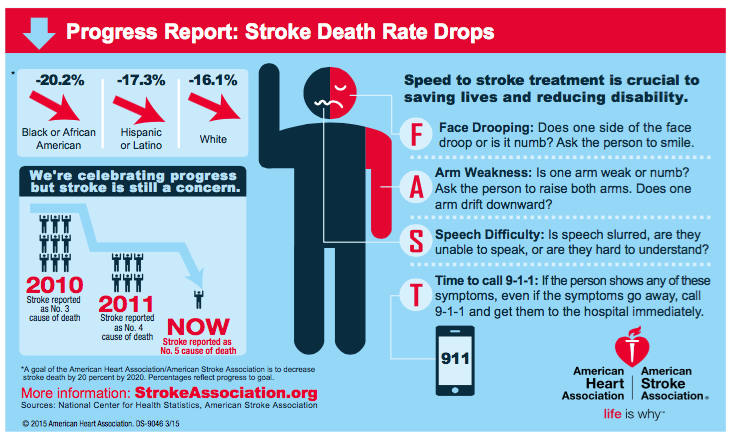
A comparison can be made to the downward trend of stroke deaths. After generations of efforts, stroke dropped to the No. 5 leading cause of death in the U.S.
For those of us who’ve devoted our careers to battling this disease, this news is incredibly exciting. The best part? We know we can still do better.
We know we can prevent even more strokes.
We know we can effectively treat stroke, improving the quality of life for survivors.
We also know we can’t do it alone.
 As a society, we need to reduce risk factors. Systems changes such as anti-smoking laws and getting food companies to reduce sodium in their products are important steps. People also need to make changes in their own lives, and their doctors need to treat their underlying conditions.
Let’s use a new analogy: a car. The best way to make it last is by taking care of it. Routine maintenance is important.
So is fixing things when they go wrong. Following this formula can help a car make it past 100,000 miles without major problems. Eventually a car’s age will catch up to it, but by then, it can have traveled a lot of miles.
Like the hoses and belts of a car, a person’s blood vessels wear out over time. Yet, the less strain and the better care you provide, the better they can be when they age.
There’s an accumulative effect of risk factors over time. So everyone should take stroke risk factors seriously.
 We also need to improve awareness of the stroke warning signs. More people need to recognize more quickly when someone is having a stroke. This is critical because we know that when treatment is delayed, brain is lost.
Here’s a “F.A.S.T.” way to remember stroke warning signs. If you see (F)ace drooping, (A)rm weakness or (S)peech difficulty, it’s (T)ime to call 9-1-1.
Every second counts when someone is having a stroke. The sooner treatment begins, the more likely a patient is to have a good outcome and the less likely they are to die from a stroke.
And we do have effective treatments such as tPA and devices to open up occluded blood vessels and medications and devices to fix ruptured brain aneurysms and blood vessels.
The next layer in our progress against this disease is improving recovery by finding more and better ways to help people who have substantial brain injury from stroke.
I often say the future of stroke research is how we can enhance stroke recovery. Many people fear the consequences of living with stroke more than dying from a stroke—the loss of a career, the inability to drive, needing others to provide basic daily care for you. The physical and emotional cost is incalculable; the financial burden is rough, too.
So, to me, the news about stroke dropping to the No. 5 cause of death in the U.S. is exciting, yet not quite worthy of a ribbon- cutting ceremony.
It feels more like halfway point in construction. Joseph Broderick, M.D. is director of the University of Cincinnati Neuroscience Institute and chair of the American Heart Association/American Stroke Association’s Stroke Council.
