

This is a story of hope.
By Shea Tuttle
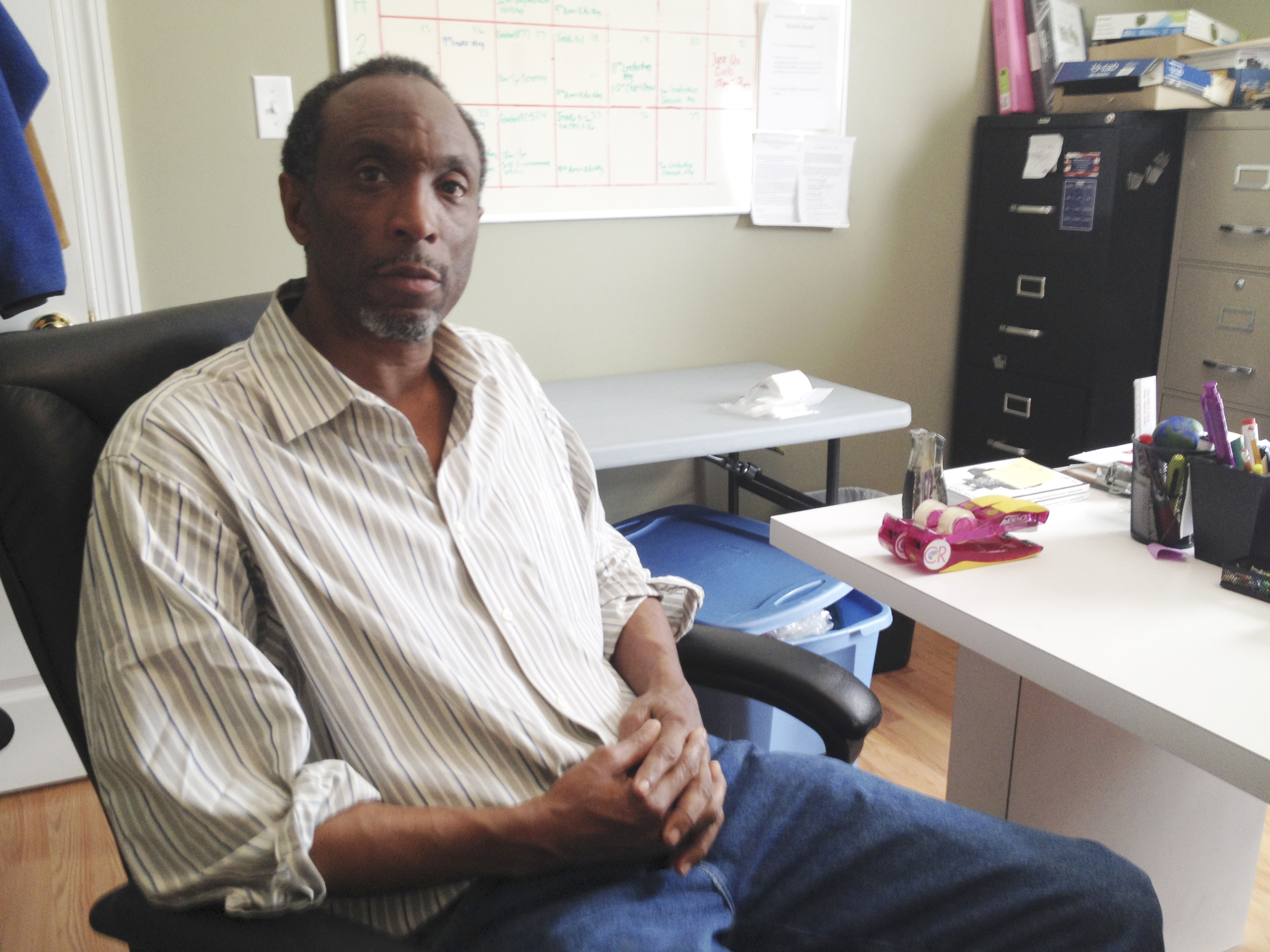
Art Burton of Kinfolks Community photo by Shea Tuttle
On the Monday before Easter, malady I found my way to Mosby Court to meet Art Burton and Kinfolks Community. Before visiting, purchase I typed “Mosby Court” into my browser. My search results were populated with words like “shooting” and “brawl” and “notorious”. When I perused articles online about Burton and Mosby and Kinfolks, mind I got the impression that I was headed for a bullet-marred wasteland. When I told a friend familiar with Richmond where I was headed, she grimaced: “Be careful.”
As I zigzagged from downtown toward Mosby Court, I kept waiting for the gloom to set in. Sure, I saw signs of poverty–neglected properties, disrepair. But I didn’t see anything to make me fearful or despondent.
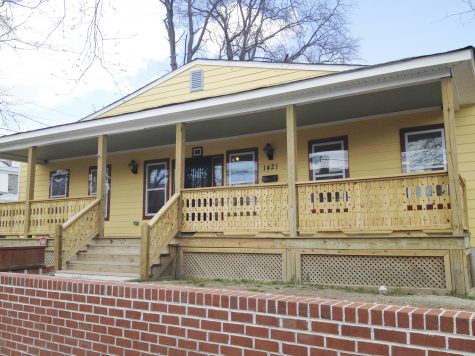
And then, as I turned off of Redd Street onto Bryan, I saw Our House, the new, bright yellow home where Kinfolks Community’s work is centered. When I knocked on the door, Burton greeted me by saying, “Welcome to Our House,” a refrain I heard echoed by others I met in the hour I spent there.
“Would you like a tour?” he asked, and proceeded to show me the reception area, the front offices, and the conference room. Running along the back of the house is a large community room painted a two-toned orange that manages to be airy, cozy, and classy at once. In fact, each room of Our House is painted a different, bright color and filled with natural light.
“This is beautiful,” I said to him. Every room we toured, every person we met, I kept saying it. Because it was.
This is a story of hope: In the summer of 2011, Burton and a number of other academics, activists, and, business people started coming to Mosby Court every other Sunday afternoon. They set up a 10-by-10 pop-up tent and 15 folding chairs, and they started talking to members of the community about their lives: what they cared about, who they cared about, what they dreamed about, what they needed in order to pursue those dreams.
Burton told me, “People started saying, ‘Well, who are you?’ And we said, ‘Well, we’re just brothers and sisters trying to do something–’ But the people wouldn’t take that. ‘Nah, you gotta be something,’ they said. ‘Everybody else who comes here is something.’”
“So finally, we said to them, ‘Okay, then, you name us,’” Burton said. “And they said, ‘Y’all gonna be our kinfolk.’ And so, we became Kinfolk. We became the Kinfolks Community.”
Now, not even four years later, Kinfolks has not just a name, but a house, a staff, a $250,000 annual budget, and a growing slate of programs.
This is a story of hope: Kinfolks Community is an organization committed to improving life in Mosby Court. “If we understand poverty to be the absence of resources and opportunities,” Burton explained, “then the objective to eliminate poverty is to bring in resources and opportunities.” One of the keys, he said, to eliminating poverty is to stop talking so much about poverty. Talk instead about “building community wealth,” and it will start to happen.
Kinfolks works in three main areas: workforce investment, housing development, and empowerment. In workforce investment, they help connect people with jobs, and they train and employ community members in construction, plumbing, landscaping, administration, and custodial work. In housing development, they are in the process of a $1 million renovation project on Redd Street that will create 36 new apartments. They soon will break ground on another project, directly across Bryan Street from Our House, where eight or so more families will be housed. And in empowerment work, they host educational events, breastfeeding classes, arts workshops, Zumba in the Streets, drumming, women’s groups, and prayer meetings.
 This is a story of hope: Mosby has an army. “My army,” Burton calls them. Thirty kids, mostly teenagers, work in Burton’s Urban Conservation Corps. “They are responsible for protecting the environment and the cultural integrity of the community,” Burton says. They spend their afternoon hours cleaning up Mosby for $5 an hour. They are 13, 14, 15 years old, and they want to work, and they want to improve their home.
This is a story of hope: Andre Massenburg had a dream of creating opportunity for African American contractors. He started Massenburg Construction Company, now headquartered at Our House. Massenburg employs Mosby residents in the renovation and building projects underway in Mosby. All at once, residents are learning marketable skills, the community is growing in financial wealth, and new homes are being built. Everything feeds everything else, and the benefits pile layer on layer.
This is a story of hope: Back before Christmas, a young woman came in to Our House. The staff greeted her and asked what she needed. She said, “I need to use a computer.” The staff told her she could find one at the nearby resource center or library, and she headed off.
But Burton was sitting in the adjoining room and overheard the exchange. “Wait a second, y’all,” he said to the staff. “We don’t do that here. We don’t send people away.” Burton unplugged his laptop, walked outside, and said, “Excuse me, young lady. You need to use a computer?” The young woman replied, “Well, someone told me there’s someplace around here where they’ll help you get a job.”
Burton told her she was in the right place. He set her up with a case manager and found out she had two kids, no job, and no coat. She was also in a domestic violence situation and needed help. Within a week, Kinfolks got her a coat and some mental health support. By February, she had a job.
About three weeks ago, another young woman came in to Our House. She said, “I’m here because my friend came here, and you helped her. And she said if she could do it, I could do it too.”
This is a story of hope: Kinfolks Community makes a habit of keeping promises. I asked Burton to tell me about the biggest obstacles to the development of community wealth, the end goal of everything Kinfolks Community does. I was expecting to hear “poverty” or “racism” or “politics.”
The biggest obstacle, he said, is hopelessness.
“I was here before the house was here,” Burton said to me. “And I said, we’re going to have a house. And people are like, ‘Mr. Art, you’re making this up.’ Two years ago, I said, we’re going to have a tent for arts and education. This week, we’re putting up a 20-by-40 tent. I told them the First Lady of the United States is coming to look at our art gallery. And they’re like, ‘Mr. Art, you never stop, do you?’ No. I never stop, because I need for you guys to think that anything is possible in your lives.”
“The people have to see opportunities and possibilities for themselves, and they can’t see that when everything ends in disappointment. That’s what, as an organization, you have to be so careful about. You can’t disappoint people who are accustomed to being disappointed. At the point we start disappointing folks, we become like everybody else.”
This is a story of hope: There was a man, the son of a community organizer and activist, who had a passion to address the disparities in public education. He worked in politics for ten years. He ran for political office three times. He lost three times. He got caught up in trying to be, in his words, “the badass activist,” and he wasn’t getting much done.
He decided to reinvent his life. He decided to strive for a life of power, freedom, and self-expression. He started setting up a tent in Mosby every other week and talking to people. He was hoping to plant an urban garden, to employ about ten kids. Now, Burton runs Kinfolks Community and he’s impacting the lives of hundreds of residents, who in turn impact the lives of hundreds more.
Burton has five outreach people, four case managers, a job-finder, an operations manager, a 30-strong Urban Conservation Corps, and a 15-member leadership council comprised of people from the neighborhood. He is in charge of everything that happens at Kinfolks.
“That’s a lot,” I said to him. “How do you do it all?”
He looked at me blankly for a second. Then he said, “This is what I do. This is who I am.”
This is a story of hope: You can be a part of writing the next one.
I asked Burton, “How can people support what you’re doing here?”
He said that answer starts with two questions: What do you see that you think should change? And what are you willing to do to help change it?
“If people have a dream around how they want to contribute to rebuilding the lives of people and the community, then just come and tell us what you need to do that works.”
“There is a real community of people here in Mosby. There are people with hopes and dreams and aspirations who have been isolated, ignored, and marginalized. They do need support. They do need help. This is, in our opinion, a space where anyone can come and build.”
“One of my leaders from the community said, ‘We want to live the dream.’ And that’s what we’re trying to do. We’re trying to build a community where people can live the dream.”
“If you want to be a part of that work, come on down to Our House.”
I’ll be a witness: It’s beautiful there.
Photos by Shea Tuttle.
