
To hope is to risk despair… But risks must be taken, because the greatest hazard in life is to risk nothing. –Anonymous
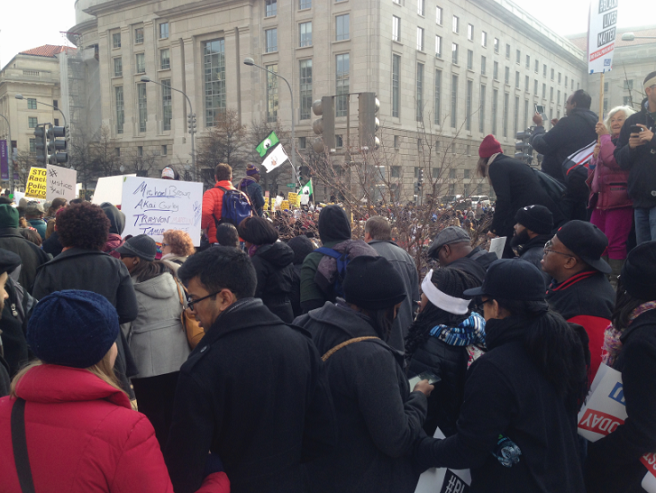
Photo Credit: Dr. T
A week ago there was a March for Justice held in our nation’s capitol while simultaneously happening in New York City and organized in other major cities all over the U.S. Millions of people marched in solidarity galvanized around the hash tags: #JusticeforAll and #NoJusticeNoPeace. A multiethnic, multicultural, and populous gathering of people all over the country chanted in a unified voice: “Hands Up Don’t Shoot!” “I Can’t Breathe!” “No Justice! No Peace!” The march was called for and organized by the National Action Network under the leadership of the Reverend Al Sharpton and the NAACP. Gathered there on Freedom Plaza in Washington, DC, over 25,000 people marched towards the big white dome of the Capitol at the end of Pennsylvania Avenue. The time and place were extremely symbolic, poignant, and powerful. There on the pavement, with a soft police presence that maintained a respectful distance, we gathered and marched, chanted, and were inspired by voices young and old, Black and white, Asian and Latino with a collective passion and outrage. We listened to the families and the mothers and fathers of Eric Garner, Michael Brown, Tamir Rice, Sean Bell, John Crawford, III, Trayvon Martin, and Amadou Diallo cry out for justice.
Kadiatou Diallo, the mother of Amadou Diallo, spoke with such incredible strength and grace to the hushed crowd. In February of 1999, her son, Amadou Diallo was standing in the vestibule of his Bronx apartment building when four white police officers mistook him for a rape suspect. They ordered him to show his hands; Diallo tried to show them his wallet. The officers mistook it for a gun, and fired 41 bullets into his body. Amadou Diallo was 22-years old at the time of his slaying. The officers were acquitted of murder charges a year later. The outrage and controversy around the shooting set in motion some changes in police training procedures and numerous studies of how racial bias influences the decisions made by law enforcement on whether to shoot or not to shoot. As Ms. Diallo stood on the podium, her words were so honest and clear, she said:
“We can come together not only to protest, not only to march, but for something positive so we don’t have this happen again. We’ve been through this so much, too much since my son Amadou was killed. It’s been sixteen years since Amadou was murdered and despite similar killings, seemingly no progress has been made to stop these killings from happening again and again. Protests only go so far until it seems like we just move on and put everything under the rug and pretend like nothing is happening.”
We do like to pretend like nothing is happening. We like to believe that hope is enough. If we hope more and believe that peace and justice must come to us all merely because of the Hope we share, we are delusional. “Magical Thinking” and denial that after decades of laboring in the struggle for equality and justice for Black Americans, we have failed to achieve our goals is heartbreaking. So it is easier to pretend that the work has already been done because actually DOING the work of fighting for Justice and Equality is just too risky. America we have a PROBLEM.
 Dr.T
Dr.T
Tawnya Pettiford-Wates, Ph.D.
Founder and Artistic Director
The Conciliation Project and
Associate Professor
Virginia Commonwealth University
DrT@Margins2theCenter.com
www.theconciliationproject.org
Up Next Week: What about Bill Cosby?
