

By Erika Winston

Summertime is finally here and Richmond area kids are flocking to local pools, with hopes of staying cool and having some water fun. Unfortunately, many of these children can do little more than splash around, as they are unable to swim. According to the Center for Disease Control (CDC), 20% of all drowning fatalities involve children under 14-years-old. Additionally, for every child fatality, five more are hospitalized from a near-drowning. The statistics are even worse among African American children, with fatal drownings for children between the ages of 5 and 14-years-old being three times higher than their white counterparts. These drowning rates exemplify the importance of water safety and basic swimming skills among children. Fortunately, Richmond parents have several resources available to meet this lifesaving need.
Free Swimming Lessons from the City
The Richmond Department of Parks, Recreation, and Community Facilities is offering free swimming lessons for residents at neighborhood parks throughout the city. The program is broken into three age groups, to include youth (ages 5 – 12); teens (13-17; and adults (18 and up). According to Althea Taylor, Aquatics Manager for the city, last year was the first time the program was offered and 504 participants were serviced. Coordinators are hoping to see an increase to 800 participants this year. The classes focus on an introduction to water skills, fundamental aquatic skills, and water safety skills.
“Research has proven that participation in formal swim lessons can reduce the risk of drowning in young children,” stated Taylor. “Factors such as access to swimming pools, the ability to afford swim lessons, and choosing water-related recreational activities contribute to increased drowning rates among Richmonders”.
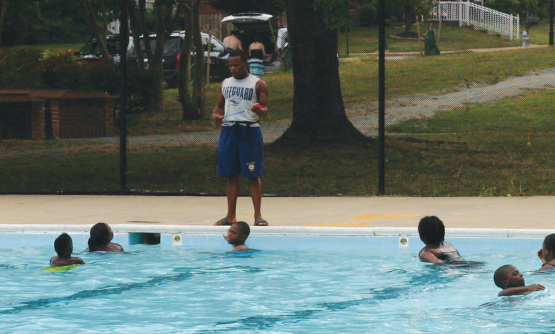
Richmond Parks and Recs operates 10 swimming pools throughout various areas of the city. According to Taylor, approximately 300 residents utilize these pools each day. To promote safety, she explains that each facility employs a staff of seven American Red Cross certified lifeguards, and most of them have at least three years of experience. Monitoring swimming ability is another precaution taken by the Department of Parks.
“Swimmers must meet a height requirement of 4 1/2 feet to swim alone at our facilities,” explains Taylor. “All patrons are required to take a swim test (swimming on your front or back 25yds, treading water for one minute, and floating on your front and back for one minute). When a patron passes the swim test, they are given an arm band which assists lifeguards in identifying and recognizing swimmers. If a patron does not have an arm band, they are not allowed in deep water.”
Interested residents are asked to register at any of the participating pools by July 28th in order to participate in the second session. A list of participating pools is located on the Parks and Recreation’s website.
“Drownproofing Richmond”
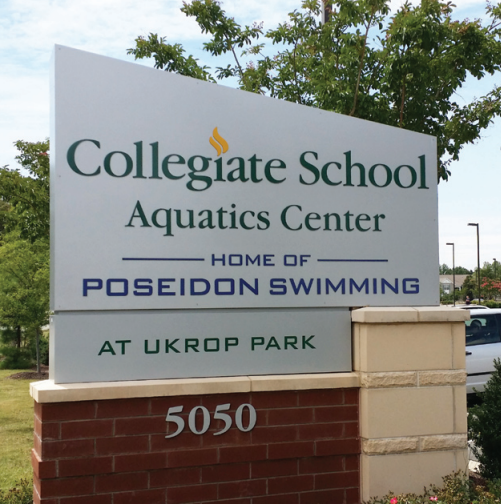
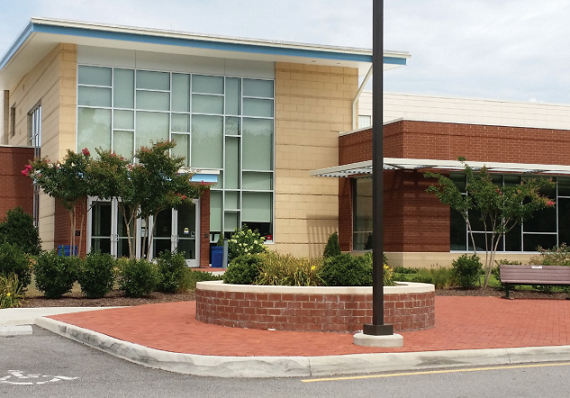
“To drownproof Richmond is the ideal goal.” These are the words of Adam Kennedy, Executive Director of the Collegiate School Aquatics Center. The Chesterfield facility offers a variety of water activities to Richmond area residents of all ages and swimming capabilities.
Kennedy expresses concern about the number of Richmonders who are unable to swim. “Half of the population doesn’t know how to swim,” he stated. “We want to change that and we think we can change that.” He went on to explain that the change involves extending aquatics access to all, “regardless of income, race, or geographic location.”
The Aquatics Center offers a large variety of programs within its facility. Swimming lessons are available in a group setting or through private coaching. Infants as young as 6-months-old can participate in parent and child classes. Adult swim classes are also available, as are various water exercise programs. The promotion of fitness is an important objective for the Center. The aquatic options are meant to prevent childhood obesity and promote wellness among elderly adults. “Aquatics takes gravity out of the equation,” explains Kennedy. “Aquatics is the only activity that allows physical fitness throughout our entire lifetime.” He went on to discuss how injury or aging can limit mobility. “A senior may not be able to walk through the neighborhood, but they can get into the pool.”
Increasing Aquatic Access
In an effort to drownproof Richmond, the Aquatics Center partners with various area agencies to provide swimming lessons and water access to children throughout the metropolitan area. One of those partnerships involves the YMCA and an initiative called “The Learn to Swim Program”. According to Kennedy, the goal of the project is to place a seven lesson swimming curriculum in every school of the region by 2020. Through the work and effort of the YMCA and area school systems, that goal is in reach.
The program is aimed at second grade children. With parental permission, the children receive seven weekly swimming lessons during the course of the school day. Each school is assigned to a conveniently located pool, where the children are transported weekly for a 45 minute lesson. Kennedy explains that the first lesson focuses on water safety techniques, while the other six are dedicated to swimming instruction. The goal of the program is for each child to swim 5 to 10 yards, without assistance. The entire process only requires about an hour and a half outside of the school each week. “The program is in 56 elementary schools throughout the region now,” stated Kennedy.
Another valuable collaboration for the Aquatics Center is its partnership with the Richmond area Salvation Army. The Church Hill Boys and Girls Club houses a five-lane, 25-yard pool that is currently inoperable. Through its advisory role, the Center assisted in identifying funding to assist in making the pool operational again for kids in the area. Once the repairs and upgrades are made, the pool will provide aquatics access year-round to the Church Hill area.
“We are an advocacy engine for aquatics in the Richmond region,” stated Kennedy. He hopes that other aquatics organizations will join in the creation of collaborations, working together to increase access and educate the public about the numerous benefits of water activity and safety.
