

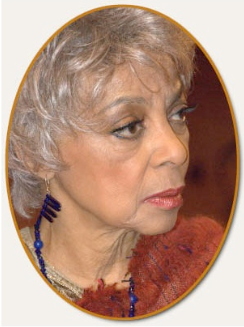
Her professional career on stage and screen spanned over 70 years, doctor and her royal marriage to the brilliant actor, director, writer and humanitarian Ossie Davis lasted for more than 56 years until his death in 2005. She was a pioneer and advocate for black actresses in Hollywood, crafting roles beyond the mammy, maid, or whore. Ruby Dee died quietly at home, last week, surrounded by her children and grandchildren. She peacefully closed her eyes and took her rest. Beyond her artistic prowess, Lady Ruby Dee was tirelessly committed to the struggle for civil rights, justice, and equity for all people. She walked with Dr. King and Malcolm X and was in attendance at the funerals of both. What a life!
I was never fond of “cowboy” movies for a number of reasons, but topping the list was the complete absence of black people; the vilification of Native Americans; the glorification and/or victimization of white culture; and the prostitution of females in either the kitchen or the bedroom with portrayals having a complete lack of autonomy in the characterizations of women in traditional Hollywood western films. Ruby Dee, Sidney Poitier, and Harry Belafonte helped me to recognize the deficit was in the films that Hollywood was making and the stories they were telling, not the genre itself. Ruby Dee influenced my opinion when she starred with Sidney Poitier and Harry Belafonte in Poitier’s directorial debut “Buck and the Preacher.” They were all heroes in the film, and Ruby Dee held her own riding and shooting alongside the men in the “pseudo spaghetti western.” Dee spoke up and stood up with style, grace, talent, and wit! She inspired me by her portrayal in that film and taught me that to be female in film or on stage did not mean to be weak, small, used by men, black or white, or stereotypical in my portrayal of what being black and female really means. Recently viewing the film made me appreciate its subversive and potent messages in a more cogent way than I did back in 1972 when the film was first released. Not only did the film speak to the socio-political inequities and injustices of the times then, but made clear and conscious connections to the present in which we lived in 1972.
Ruby Dee worked consistently throughout her substantial career, and she and Ossie Davis had both a successful marriage and family. They were not in the tabloids and they worked and lived in such a way that the legacy they left was one in which their children, family, and community could be proud. I had the great privilege to meet them, to shake their hands, to listen to their counsel, and to be entertained and inspired by them both. Lady Ruby Dee will always be an example for young black women in the arts. She defied the odds against her and was undaunted by the proverbial “stacked deck.” She defined herself as a woman and an artist, and in so doing she confronted the Hollywood stereotypes and caricatures of black love, black people, and women. She broke down barriers with artists like Lorraine Hansberry, Spike Lee, Poitier, Belafonte, and others and challenged the consciousness of a nation with the likes of Malcolm X, Dr. King, Medgar Evers, Rosa Parks, and more. Though she’ll be missed, the life she led and the legacy she created will always inspire us. You are with us forever Miss Ruby Dee. #withtheAncestors
 Dr.T
Dr.T
Tawnya Pettiford-Wates, Ph.D.
Founder and Artistic Director
The Conciliation Project and
Associate Professor
Virginia Commonwealth University
DrT@Margins2theCenter.com
www.theconciliationproject.org
Up Next Week: Two-Faced People
