

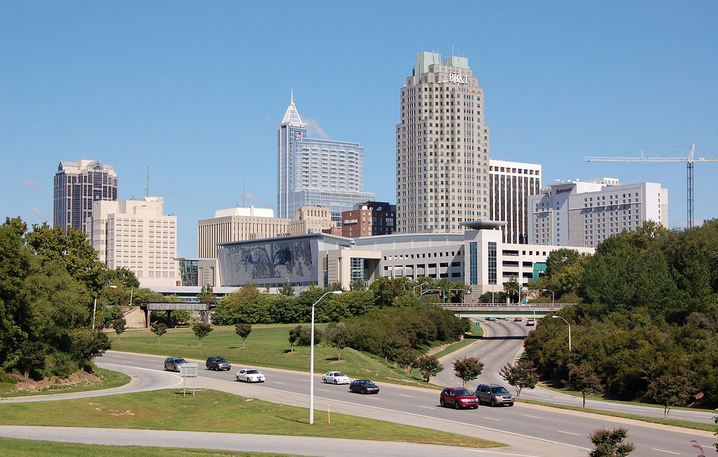
The Top 10 Cities for African American Professionals series continues with city number five. The list delivers information such as a city’s crime rate, treat employment opportunities, help and institutions of higher education. The purpose of this list is to provide people with an opportunity to receive an overview of the city without looking all over the internet.
Last week, Dallas was the featured city. Urban Views Weekly looked into the third largest city in Texas and saw that it was great for entertainment and working in the science and defense industries. This week, however, the spotlight is on Raleigh, a very research-driven city and North Carolina’s capital.
The list:
- Washington, D.C.
- Houston, Texas
- Atlanta, Ga.
- Dallas, Texas
- Raleigh, N.C.
- New York City, N.Y.
- Charlotte, N.C.
- Indianapolis, Ind.
- Columbus, Ohio
- Jacksonville, Fla.
Info and numbers from cities taken from the United States Census Bureau website (census.gov) and city-data.com.
Raleigh, North Carolina
Gender percentage: Female 51.7 percent, Male 48.3 percent
Median Age: 31.9 years old
Percentage of African Americans: 29.3 percent
Raleigh is in the nation’s top 100 largest cities; it ranks at number 42. It is also North Carolina’s second largest city. With such rankings, that means the city has plenty for everyone to do. Vernessa Roberts, Vice President of Communications at The Greater Raleigh Chamber of Commerce, said the city is right in the middle of everything, in the middle of north and south as well as between the mountains and the oceans. “The weather is so nice, the neighborhoods are so safe, and the housing market is, well, so healthy and affordable,” Roberts said. “The grass really is greener here with our average year-round temperature of 70 degrees. We’re consistently rated as one of the best places in the nation to raise a family, stay healthy, access first-rate healthcare, find a mate and enjoy the outdoors.”
Specifically geared toward African Americans, there is the African American Cultural Complex. This museum, according to the Raleigh tourism website, is “a collection of all the contributions made by African Americans’ development of North Carolina and America.” Achievements in science, business, sports, politics, medicine and the arts are all showcased in this museum.
Raleigh is also a biking town. In order to appeal to more bikers, the city’s website says it just received a $1.1 million grant from the Federal Congestion Mitigation and Air Quality Improvement (CMAQ) program to build 27 miles worth of infrastructure with bike facilities on the pavement. The proposed idea, which began in 2008, is scheduled to be finished in 2015. Raleigh is very biker-friendly, so for those who have a short commute to work it’s the perfect city for biking. There are also numerous trails and paths for those who want to exercise as well.
Percentage of those with Bachelor’s Degree or higher: 46.8 percent
The historic city of Raleigh is home to many universities and colleges. Shaw University, the oldest HBCU in the South, is a private university. The school is noted for having the first four-year medical program in North Carolina and for African Americans in Leonard Hall. The Shaw University Divinity School is nationally renowned. What Shaw is most known for, however, is its business school. Shaw has produced a number of successful and wealthy entrepreneurs such as Willie E. Gary (multi-million dollar attorney and cable television executive) and Lee Johnson (CEO and president of Mechanics & Farmers Bank).
North Carolina State University is also located in Raleigh. It’s a public research institution that is known for being one of the three corners of the Research Triangle of North Carolina that includes NCSU, Duke University, and University of North Carolina Chapel Hill. NCSU’s main area of research includes forensic science, where the school’s Forensic Science Institute focuses on anthropology, archaeology, chemistry, entomology, geology and forensic photography.
Average Salary: $53,699
Top Industries (according to Forbes.com): Technology, Healthcare and Education
It seems Raleigh is a city that is all about the welfare of its people. The top three industries in the city are involved in helping individuals advance, making their lives easier, and preparing them to be competitive professionals in the working world. In Raleigh, Research Triangle Park provides most of the jobs in all three of its top fields. As a “global epicenter of technological innovation,” RTP is home to 170 global companies such as Cisco Systems, DuPont Electronic Technologies, and IBM. The average salary of someone working in the technology industry, according to Indeed.com, is $57,000. The fields of healthcare and education are available through the universities in the triangle (Duke, UNC Chapel Hill and NCSU) that provide not only education but medical training and assistance to both students and employees in the park.
Crime Rate (Robberies per 100, 000): 166.3
As Vernessa Roberts stated earlier, Raleigh is a very safe city. Men’s Health Magazine actually ranked it as number fourteen in its 100 Best Cities for Men, which also takes crime rate into account. That is not to say that Raleigh is crime free. In 2012 it had 17 murders, 114 rapes, 672 robberies and 994 assaults. The city had more property crimes than violent crimes with 3,064 burglaries, 10,221 thefts and 940 motor vehicle thefts.
In conclusion …
As the 42nd largest city and North Carolina’s second largest city, Raleigh is an ideal place for African Americans. It is relatively safe, provides great educational opportunities, and challenges individuals to become better and more competitive professionals. It is a very historical city, and a very healthy city that is very bike-friendly. Two universities, Shaw and North Carolina State University, provide an avenue for men and women to become smarter business and research professionals. Both universities also offer history to the state of North Carolina and the United States. As far as industries go, it seems the Research Triangle Park is the main hub of Raleigh employment
