

J. Chevont’e Alexander
“Higher Achievement is like a rollercoaster. Listening to the presentation of what Higher Achievement can offer is like standing in line, waiting for the chance to do something exciting. When you first buckle yourself in, the goals and expectations pull you up, up and away. You race full speed ahead, holding on to your friends and mentors tightly to make sure they keep you on track. Sometimes, there are loops that turn you upside down and drops that make your stomach turn, but you always end up back on your feet, exhilarated and ready to ride again!” – Melvin
Talent is everywhere but opportunity is not. Higher Achievement’s mission is to close the opportunity gap during the pivotal middle school years, starting in the 5th grade. By leveraging the power of communities, Higher Achievement’s proven model provides a rigorous year-round learning environment, caring role models, and a culture of high expectations, resulting in college-bound scholars with the character, confidence, and skills to succeed. Higher Achievement was founded in 1975 by Greg Gannon, a teacher at Gonzaga College High School in Washington, DC. Gannon believed the program would address a serious and underappreciated community problem: the gap in opportunity between his Gonzaga students and the youth in the housing project across the street from the school. He founded Higher Achievement to create learning opportunities for underserved youth — so they could have equal access to success, both in school and beyond.
VIDEO: Higher Achievements, Olympics of the Mind
In 2006, with grants from Atlantic Philanthropies, the Jack Kent Cooke and the William T. Grant foundations, Higher Achievement launched the first longitudinal, randomized study of an out-of-school time program. Results from the study prompted additional investments in Higher Achievement’s expansion. In 2009, Higher Achievement opened achievement centers in Baltimore, MD, followed by centers in Richmond, VA, in 2011. In 2012, the Social Impact Exchange listed Higher Achievement as one of the most impactful nonprofits in the country.
Currently, Richmond’s youth in low-income neighborhoods do not have equal educational opportunities. They lack essential resources for academic learning during the summer and after school time that more-resourced families and communities are able to provide. Schools in Richmond’s high-poverty neighborhoods do not have the capacity to provide critical, individualized attention, and rigorous, out-of-school time learning opportunities to children who are motivated to learn. Lacking these supports, low-income children are ten times more likely than their affluent peers to drop out of high school.
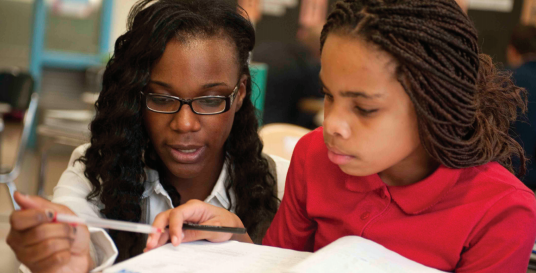
Mentors serve as positive role models to scholars while teaching math, literature and seminar subjects.
According to Richmond Public Schools, the majority of drop-outs occur in the 9th grade, because they are ill-prepared for the rigor and pressures of high school. Only 66% of children from economically disadvantaged families in Richmond earn standard or advanced high school diplomas within four years. This number drops to 59% for African American students and 19% for Latinos.
Higher Achievement’s role is to demonstrate the remarkable academic achievements that are possible when students in low-income neighborhoods are provided intense, out-of-school time academic opportunities within a culture of strong relationships, high expectations, and family engagement throughout the middle school years. Higher Achievement’s model is guided by leading research that identifies middle school as a student’s “last, best chance to succeed.”
This imperative drives Higher Achievement to intervene at the transition to middle school with a proven, year-round, multi-year program for at-risk, yet motivated, young people who want to go to college and are willing to work hard to get there. At a time when grades and test scores usually decline, our program yields results. Ninety five percent of Higher Achievement’s students attend a four-year college, and 76% graduate from college.
VIDEO: Closing the Opportunity Gap for Middle School Youth
When LeQuandre joined Higher Achievement’s Southside Achievement Center as a sixth grade student, he was incredibly shy and sometimes overlooked by school teachers. LeQuandre began working with his mentors and soon found his communication skills blossoming as the relationships with his mentors grew. With an ear always available, LeQuandre began to transform from the quiet boy in the corner to a scholar with the courage to compete in the Geography Challenge – a spelling bee like event where scholars answer geography questions on a stage in front of an audience of families, mentors, and peers. Not only did LeQuandre compete, but he won the event! With his confidence growing, he shared a secret skill with our Center Director – he was very gifted in origami. LeQuandre organized a center-wide origami competition; he spent several weeks teaching his peers how to create origami animals and took pride in judging the event. We were also pleased to see his enthusiasm during his first transition conference where we discussed his high school options with him and his family based on his academic interests. LeQuandre is now more confident and open to trying new experiences.
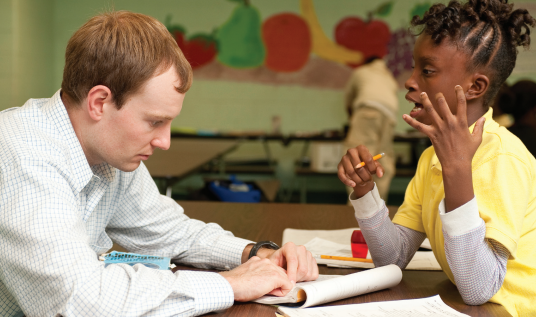
By building relationships, mentors help scholars stay in school, avoid risky situations, find positive alternatives to negative behavior, and develop a sense of resiliency.
A Community Can Invoke Change
Higher Achievement creates lasting change – putting individual students on a path to success, breaking the cycle of poverty for families, and strengthening the social fabric of communities. Scholars go on to high school, college, and careers becoming active leaders in their school and communities. Families are given the knowledge and tools to have a larger impact on a child’s college and career readiness. Schools are impacted by Higher Achievement scholars “raising the bar” for academics, behavior, and social skills among their peers. Communities embrace a culture where high achievement is the norm and anything less is unacceptable.
“Every Tuesday is a memorable experience for me. I thought I would be teaching my mentee new things, but it has surely turned out to be the opposite. Her courage and thoughtfulness have inspired me.” – Robin Hill, Mentor
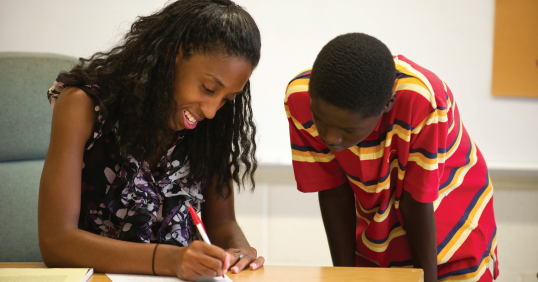
Our best mentors are caring, concerned advocates for the needs and potential of a young person and able to offer acknowledgements for hard work yet able to address inappropriate behavior.
At the request of Richmond Public Schools’ School Board, Higher Achievement Centers are based at Henderson and Boushall Middle Schools serving Richmond’s Northside and Southside neighborhoods. Scholars are recruited from these host middle schools as well as their elementary feeder schools through informational presentations to teachers. Richmond Public Schools is looking to Higher Achievement to not only prepare underserved Northside and Southside students for the transition to high school, but also to help school-wide improvement at Boushall and Henderson Middle Schools.
The majority of our scholars are those performing in the middle who need individualized attention and additional learning time to improve grades to the A/B level. Scholars who are already at the A/B level choose to participate in Higher Achievement to maintain their grades during the difficult transition to and throughout middle school as well as increase their confidence and develop leadership skills. Each scholar is motivated and committed to be on the college track by the eighth grade and be college-ready by the time they graduate from high school.
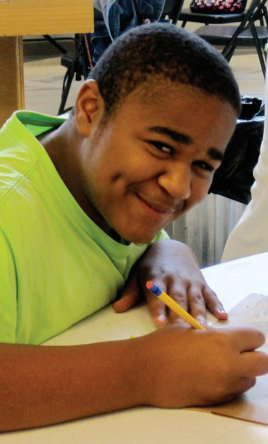
Todd creates ceramic tiles during a field trip to the Visual Arts Center. The tiles are displayed in the entrance at Boushall Middle School.
Higher Achievement’s Programs
From 5th through 8th grade, Higher Achievement scholars spend 650 hours a year learning an advanced curriculum that is aligned to state standards. This commitment is in addition to attending school for the standard 900 hours a year.
Summer Academy (June – August): For six weeks, four days a week, eight hours a day, scholars are taught math, science, social studies, literature, and an elective, such as music or art. The curriculum is correlated to national and state standards of the grade level they will be entering in the fall. Their effort not only combats summer learning loss, but also strengthens areas of weakness while pushing them to new heights academically. Scholars enter their new grade with confidence and familiarity with the coursework ahead.
Scholars are steeped in our culture of spirit, respect, excellence, and collaboration with a behavior management system that helps scholars, staff and volunteers uphold these principles. Scholars also participate in field trips that expose them to experiences outside their immediate comfort zone. A highlight of Summer Academy is an overnight college trip where scholars discuss the expectations of going to college, what it takes to get there, and to begin imagining their lives as college students. They sleep in campus dorms, eat in dining halls, attend lectures with college professors, and talk with current students about available majors and career paths.
“I feel so fortunate to be a part of Higher Achievement. I have gained valuable insight into the problems facing teachers and students in Richmond. More importantly, I know I am making a difference in scholars’ lives, and it is one of the most rewarding and satisfying things I have ever done.” – Ann-Marie Schell, Mentor
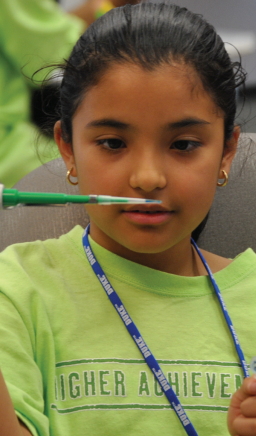
Erika enjoys the hands-on learning opportunities during the overnight College Trip during Summer Academy to the Biomanufacturing Research Institute and Technology Enterprise (BRITE) at North Carolina Central University
Recent studies show that only 34% of high-achieving high school seniors from low-income families attend the country’s most selective colleges – partially due to the fact that they have never met someone who attended one nor are they aware of the financial aid available. This is especially true of students in smaller metropolitan areas, like Richmond. By exposing scholars to a variety of universities, providing them the opportunity to build relationships with college students and graduates, and offering workshops on financial aid, as well as programs that provide encouragement and build self-confidence, Higher Achievement students are informed from a young age about the possibilities of and processes for applying to top colleges.
Past college trips have included The College of William & Mary, George Mason University, Virginia Commonwealth University, Virginia State University, North Carolina Central University, and Duke University; and this year, students will visit Old Dominion University.
Afterschool Academy (October – May): For 25 weeks, three evenings per week, 3 p.m. to 7:30 p.m., scholars receive homework coaching, an elective, dinner, and two hours of intensive small-group academic mentoring in math, literature, and self-selected seminars such as Kitchen Sink Science and Conflict Resolution. They experience opportunities to develop public speaking and leadership skills during daily Community Meetings, where scholars debate a word and quote of the week and share their solutions for the math problem of the week. Scholars display their growing academic confidence and public speaking skills during special events such as the Geography Challenge, Love Out Loud poetry competition, and the Center Ambassador competition.
High School Transition Services: When scholars reach the 7th grade, Higher Achievement begins preparing them for high school through workshops, where scholars develop their research and note taking skills, discuss the social and academic expectations they will face in high school, and participate in volunteer opportunities to understand the importance of giving back to their community. Higher Achievement helps scholars and families identify and pursue accelerated high school programs that fit their skills and interests and will keep them on track for college readiness. Options may include the city’s magnet schools or AP/Honors programs in their neighborhood school. For magnet school applications or if a family wishes to pursue private school, Higher Achievement will help them prepare for placement tests, practice interview and writing skills, complete applications, and identify resources for financial assistance when needed.
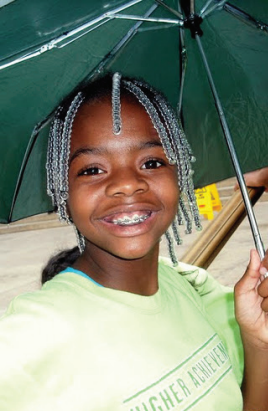
The scholars enjoyed the overnight College Trip during Summer Academy to George Mason University despite the rain!
Hard Work Yields Success
In the last year, 44% of Higher Achievement scholars improved one letter grade in literature and 39% improved one letter grade in math, while 36% of scholars maintained an A or B average in literature and 41% maintained an A or B average in math. Based on Higher Achievement’s history of results in Washington, DC, they anticipate that 93% of Richmond scholars who complete the four-year program (first class in 2014) will graduate from high school (in 2018) and go on to college. The scholars’ commitment clearly shows their motivation to be on track for college by the eighth grade and their mutual belief that intellect is built through effort.
How You Can Help
In order for Higher Achievement to continue providing a high quality program to middle school students in our community, they need the community’s support both financially and through volunteers.
Their program is not possible without the commitment of volunteers. Each year, Higher Achievement recruits approximately 150 academic mentors to work with the scholars throughout Afterschool Academy. Mentors provide high-quality academic instruction using Higher Achievement’s curriculum, build scholar character by demonstrating positive behavior and professional and personal success, and foster the community’s role in contributing to the education of young people in greatest need. By offering opportunities for scholars to meet and build relationships with positive role models, mentors help scholars stay in school, avoid risky situations, find positive alternatives to negative behavior, and develop a sense of resiliency.
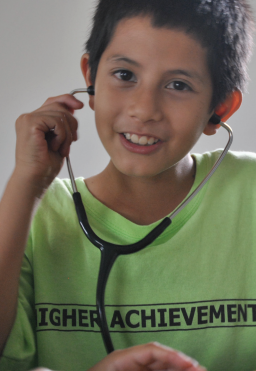
Gabriel learns about his heart and health during a field trip to VCU.
Each mentor engages a group of three 5 seminar curriculum after attending mentor orientation and training. Mentors uphold Higher Achievement’s culture of high expectations of young people and also share successes and troubleshoot challenges with other mentors and staff. Our best mentors are caring, concerned advocates for the needs and potential of a young person and able to offer acknowledgements for hard work yet able to address inappropriate behavior.
Mentors commit to our program for two hours per week for 25 weeks from early October to early May. They volunteer one day a week on Monday, Tuesday or Thursday from 5:30 p.m. to 7:30 p.m., as well as attend approximately five hours of mentor training in late September. Mentors are encouraged to attend Center events to further strengthen the bond between the mentor and their mentees. The mentors, as well as scholars, receive benefits from the commitment. Mentors build awareness about education and middle school youth and mobilize networks of people – from corporations to individuals – who otherwise would not be involved in education issues. They know they are positively impacting the academic skills, attitudes and habits of Richmond’s middle school students and feel personally fulfilled through helping to close the opportunity gap in the Richmond community. There is satisfaction in helping three young people be prepared for the college track by the 8th grade plus the opportunity to network with like-minded professionals who care about the health of Richmond and the academic success of all of the community’s children.
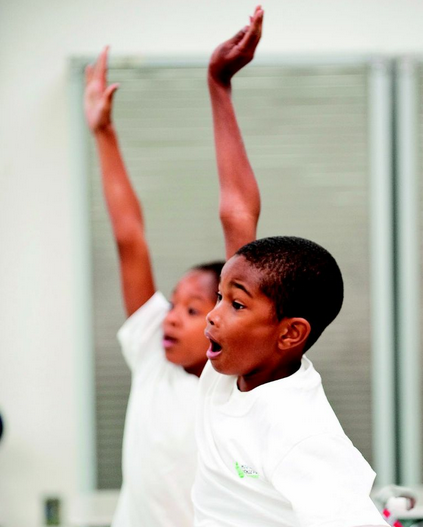
Scholars race to answer the question during Summer Academy.
Higher Achievement depends solely on contributions from people in the communities served as well as corporations and foundations.
- $25 provides Summer Academy supplies for one scholar
- $50 provides one Afterschool Academy elective class to 10 scholars
- $100 supports Academic Mentor training during Afterschool Academy
- $250 provides one week of Afterschool Academy to one scholar
- $500 supports a Summer Teacher during Summer Academy
- $1500 transports a class of scholars to the Summer Academy College Trip
To make a donation, please visit, www.higherachievement.org, or mail a check to Higher Achievement, Attn: Abigail Lapp, 1419 W. Main St., Richmond, VA 23220.
“I feel that a lot of these scholars have such great potential but may not have the resources necessary to achieve their goals. Higher Achievement is a great way to provide these children with the education and support they need to stay on track.” – Allison Osborne, Mentor
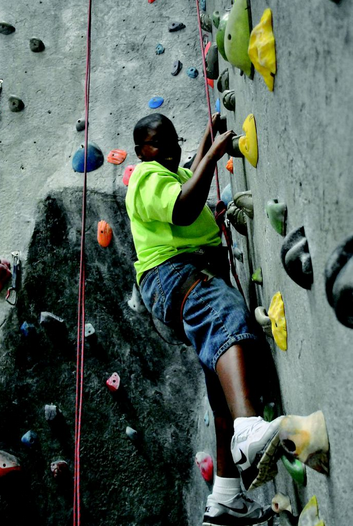
Melvin pushes himself to new height on a field trip to Peak Experiences, where the scholars also participated in a leadership session.
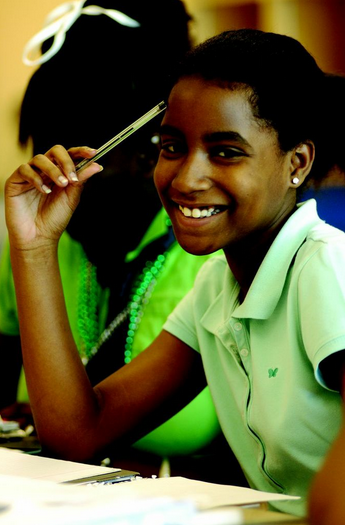
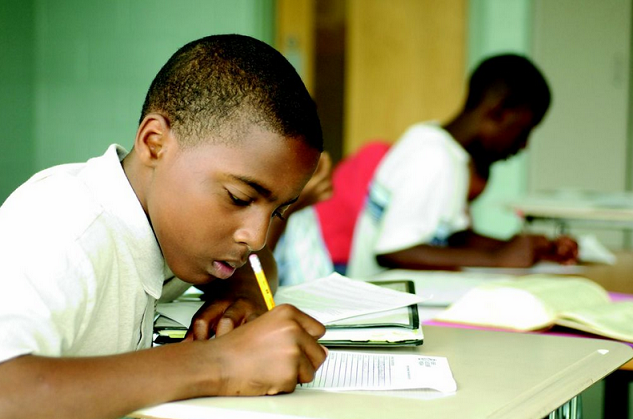
Scholars receive two hours of academic mentoring in small groups three times a week during Afterschool Academy
