

February, the month that commemorates the contributions of blacks to American society, is also National Heart Health Month–a likely pairing given that cardiovascular disease disproportionately affects black women.
A sobering statistic: heart disease is the leading killer of women. Meanwhile, 49 percent of black women 20 years of age and older suffer from cardiovascular disease, and a black woman is twice as likely as a white woman to have a stroke.

Gail Alexander-Wright
In addition, African Americans typically have higher rates of obesity and diabetes than their white counterparts, making black women more likely to suffer from high blood pressure and heart disease. High blood pressure also develops at an earlier age for blacks.
American Heart Association advocate Gail Alexander-Wright knows this first hand. A U.S. Navy reservist and business owner, Alexander-Wright would not appear to suffer from cardiovascular disease. But at 37 years old, she earned the dubious honor of being the youngest person in cardiac rehab when chest pains experienced after an exercise routine landed her in the hospital. The diagnosis? A blocked artery.
Nor did her ordeal end with a heart attack. Just a few months later, Alexander-Wright began suffering from blurred vision. After consulting an optometrist, and later a neurologist, she learned she was the victim of a condition few women her age have experienced—a stroke.
“I was so disappointed that this had happened to me, and even more upset to find out that I was doing so many things wrong,” Alexander-Wright says.
Warning signs for stroke include the sudden appearance of a severe headache, difficulty speaking, numbness on one side of the body, dizziness, confusion and loss of coordination.
But like Alexander-Wright, many black women are ignorant of these signs. According to the American Heart Association, only 52 percent of black women are aware of the signs of a stroke. Worse, only one out of five black women thinks she is at risk for heart disease.
To bring greater awareness to this problem, the American Heart Association is promoting its Go Red for Women campaign, an effort the association claims has saved 627,000 lives since the program’s inception a decade ago.
“The Go Red for Women movement has been impacting the health of women for 10 years, and as a result, 330 fewer women are dying per day,” says Patricia Lane, American Heart Association volunteer and Bon Secours Richmond administrative director neurosciences. “We should all feel empowered by this amazing accomplishment and use it as motivation to continue to fight this deadly disease.”
According to Lane, 90 percent of women have one or more risk factors that contribute to heart disease. Lifestyle factors such as lack of exercise and smoking exacerbate the problem. Research also suggests that African Americans are genetically prone to cardiovascular disease; one gene in particular makes some blacks overly sensitive to salt.
To combat the disease, the American Heart Association suggests mapping out one’s family medical history. Information, such as whether immediate family members have suffered from diabetes, stroke and high blood pressure, should be presented to a physician.
“I didn’t know that my father and all of his siblings had had heart attacks relatively early in life,” Alexander-Wright says. “I also learned that my diet was not as healthy as I thought it was. My blood sugar showed I was pre-diabetic.”
Since her heart attack and stroke, Alexander-Wright began making positive lifestyle changes. She monitors her heart rate, gets more sleep, and her eating habits have improved.
“Fruits, vegetables, whole grains and very little red meat are what I stick to these days,” she says.
Now at 41 years old, Alexander-Wright’s commitment to a healthier lifestyle has resulted in a physical transformation as well. Both she and her college-age daughter have lost more than 30 pounds.
“I have shared this journey with my daughter as well as many other women as I can because I don’t believe there is enough awareness about the disease—especially for women,” Alexander-Wright says.
Weight loss is just one road to a healthier heart. Other routes include quitting smoking and cutting back on one’s salt intake.
The American Heart Association recommends eating less than 1,500 milligrams of sodium per day. The “Salty Six”: breads, cured meats (such as cold cuts), pizza, poultry, soup, and sandwiches can contain up to half of the daily recommended allotment of sodium. Some foods, such as a hamburger from a fast food restaurant, can exceed the 1,500 milligram limit.
“With the right information, education and care, heart disease in women can be treated, prevented, and even ended,” Lane says.
For more information, visit GoRedForWomen.org.
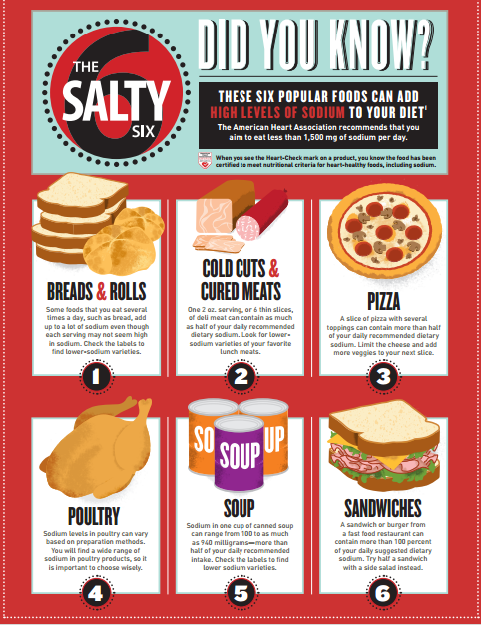
http://www.heart.org/HEARTORG/General/Salty-Six---Common-Foods-Loaded-with-Excess-Sodium_UCM_446090_Article.jsp
