

By Mechelle Hankerson
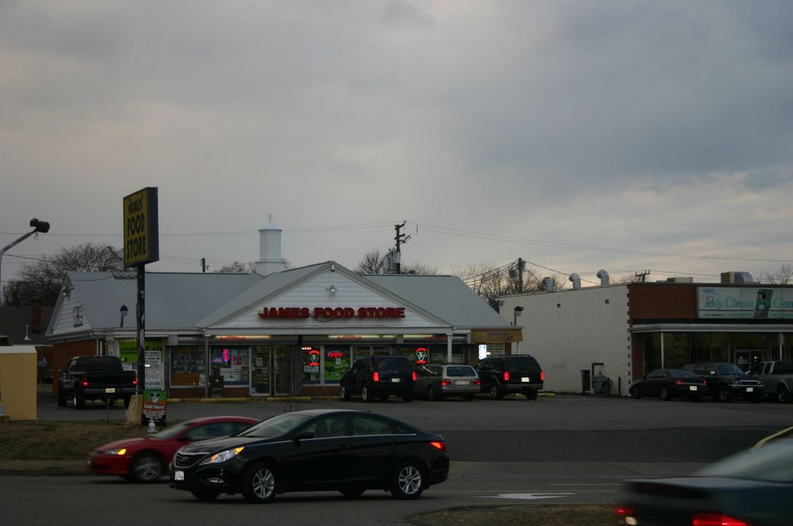
The Farm Fresh at the intersection of 25th and Main streets looks like a normal grocery store. Paper cutouts in the shape of hot air balloons decorate the windows to advertise for medical research donations. Families, usually with young children, come in and out with enough bags to suggest they’ve only bought dinner for the night.
In the parking lot, cars struggle to back out of spaces and negotiate the small space to exit and enter. Inside, shoppers wait in one of the eight checkout lines and overflow into the aisles of food. The shoppers put up with it, mostly because it’s the only viable option unless they want to travel about 10 miles to Kroger near Laburnum Avenue or about three miles across town to the Kroger on Broad and Lombardy streets.
The east end of Richmond didn’t always look like this.
Longtime Church Hill resident Mary Thompson can remember when there were multiple large grocery stores in the area so residents weren’t clamoring for parking spots, checkout lanes or to get the best pick out of the small selection of food and produce.
She’s lived in the neighborhood her whole life — 75 years — and can remember small strips of businesses with ice cream shops, small specialty stores and service-based stores, like barbers. By the time the early ’80s came, Thompson said most of the stores and business strips had vanished from the neighborhood.
“Families started moving out of the community and I think that the business people that were here saw that the demographic was changing and thought business was in danger,” she said.
As businesses and families moved toward the suburbs, so did the opportunity for easy access to full-service grocery stores.
Neighborhoods like Church Hill aren’t a new phenomenon in the United States. In rural and urban areas throughout the country, residents’ accessibility to stores that can provide their basic food needs is decreasing as businesses move to the suburbs with the families that regularly use their services and can spend significant amounts of money on groceries without the use of public assistance programs.
Areas without immediate and easy access to grocery stores have been named “food deserts,” by government agencies. The U.S. Department of Agriculture (USDA) tracks these food deserts through their online food desert locator and currently has 6,530 deserts documented nationwide.
According to the locator, there are 194 food deserts in Virginia. Richmond is home to 12 of these deserts.
Most of Richmond’s deserts are on the south side of the city. There is one in the Barton Heights neighborhood and there are others that border the Fairmount and Church Hill neighborhoods.
The food desert locator was implemented as part of First Lady Michelle Obama’s “Let’s Move!” health initiative to help track areas with low access to healthy food. The initiative formed the Healthy Food Financing Initiative (HFFI) Working Group, which officially defined food deserts as “a low-income census tract where a substantial number or share of residents has low access to a supermarket or large grocery store.” To be considered low-income, the area must have a poverty rate of 20 percent or more or median family income at or below 80 percent of the area’s median family income. To be considered low-access, at least 500 people or 33 percent of the area’s population must reside more than one mile from a grocery store. In rural areas, the same number of people must be at least 10 miles from a grocery store.
For some Church Hill residents, like Church Hill Association president Jon Ondrak, leaving the Church Hill food desert isn’t difficult.
“People who can afford it and have transportation go somewhere else,” he said. Ondrak said the residents that can, often go to Carytown or to the West End to shop for groceries.
Thompson often shops at Kroger on Williamsburg Road, near Laburnum Avenue, but knows how hard it can be for residents who don’t have reliable transportation to have easy access to stores. She often drives her neighbor to the store so she doesn’t have to take a bus.
Thompson lives on the 1100 block of 22nd Street and the closest grocery store to her is the Farm Fresh at 25th and Main streets.
“It’s walkable, but at my age, I wouldn’t walk,” she said. “I would have to catch public transportation and then it doesn’t run directly (to the store). I’d have to get off the bus and then walk down the hill to the grocery store.”
Even when stores like the Farm Fresh are relatively accessible, both Ondrak and Thompson agree that the stores’ selections are subpar. For Ondrak, he said he thinks the store provides the bare minimum to cater to the neighborhood’s population that relies on food stamps or the WIC program.
“I will go out of my way to not shop at (Farm Fresh) … they’re catering specifically to that sub-population that is on public assistance,” Ondrak said. “Their fresh produce is not anything close to standard.” Ondrak said most of the products at the store are WIC-approved and there is little selection beyond those items.
The issue of the East End’s food desert runs deeper than just food accessibility and quality. For residents like Thompson, getting another grocery store means economic revival for a neighborhood that she said used to be one of the economic leaders in the city.
Megan Gough, an assistant professor of urban and regional planning at Virginia Commonwealth University works with students to develop neighborhood plans for communities in Richmond. Recently, she and her students have focused on the eastern side of the city, around the Church Hill and Fairmount neighborhoods.
Gough said most big grocers tend to avoid neighborhoods like Church Hill and Fairmount because of the potential economic risk — something she said is perpetuated by the small number of already established businesses in the area.
“It becomes kind of a vicious cycle … for communities,” she said. “They aren’t able to attract more people (and) more populations to their communities, especially populations that are going to bring a different type of income to it … from a city’s perspective, it’s quite a threat especially if you’re trying to create a thriving central business district.”
City councilwoman for the 7thDistrict, Cynthia Newbille has been working to try to lobby companies to bring other grocery stores to the Fairmount and Church Hill neighborhoods. She has talked to Kroger, Ukrop’s and Giant. Ondrak participated in the planning process through the East End Charette, a gathering of citizens and community organizers who discuss and plan strategies for neighborhood improvement. He said Newbille’s negotiations have come down to talks with Wal-Mart and, for the most part, have been stalled.
Thompson, who also participated in the Charette and follows Newbille’s progress, said she will keep offering rides to her neighbor and continue to support Newbille’s cause no matter how long it might take.
“It’s really hard on these people,” she said. “That’s why I’m just working so hard in the community to see if we can get another grocery store for the people.”

1 comment
[…] It’s easy to tell people to eat healthy and suggest adding more fruits and vegetables to their diet but the truth is that eating healthy can be expensive. In Richmond especially it can be hard to find a grocery store that can fulfill your fresh produce needs. […]
Comments are closed.