

By Camisha Jones
First diagnosed with glaucoma around the age of 6, Michael Davis knows a lot about transcending the disease’s limitation. While pregnant with him, Davis’ mother was in a car accident that seemed to cause only minor injuries. Months after his birth, however, Davis developed severe cataracts and later glaucoma that drastically impaired his vision. Having endured 23 surgeries, bullying in school and discouragement from participating in sports, Davis is now employed, happily married, qualified to run the 2013 Boston marathon and the current chairperson of the Department for the Blind and Vision Impaired (DBVI)’s State Rehabilitation Council.
Davis proves that it is possible to live a full and rich life despite even the most extreme effects of glaucoma. Doing so, however, begins with awareness. “Awareness is so important,” explains Davis, “because people are afraid to ask questions (and)… if you don’t ask how will you know?”
January is Glaucoma Awareness Month, inviting our community to learn how to live well in spite of the prevalence of glaucoma within the African American community. “Glaucoma affects more than 2.7 million people nationwide and is a leading cause of vision loss and blindness in African Americans. In fact, African Americans are at risk of developing it at an earlier age than other racial and ethnic groups,” said Dr. James Tsai, chair of the Glaucoma Subcommittee for the National Eye Health Education Program of the National Institutes of Health’s National Eye Institute (NEI). The more than 520,000 African Americans who have glaucoma account for the highest number of glaucoma cases among all minority groups and those numbers are on a steady rise. In fact, the NEI expects there to be a 66% increase in the number of African Americans with glaucoma by 2030.
Glaucoma has many forms. Each can cause damage to the eye’s optic nerve where images we see are transferred to the brain. In primary open-angle glaucoma, the most common form of the disease, there is an increase in eye pressure resulting from a buildup of fluid in the front chamber of the eye. “Primary open-angle glaucoma often has no early symptoms. However, as the disease progresses, a person may eventually notice his or her side vision decreasing. If the disease is left untreated, the field of vision narrows and vision loss may result,” states Dr. Tsai.
Other forms of the disease include normal-tension glaucoma, closed-angle glaucoma, congenital glaucoma and secondary glaucoma. In normal-tension glaucoma (or low-tension glaucoma), optic nerve damage and field of vision loss occur in the absence of an increase in eye pressure. People who are farsighted or of Asian descent are of greater risk for closed-angle glaucoma (also referred to as narrow-angle glaucoma or angle-closure glaucoma). Much less common than other forms of the disease, closed-angle glaucoma occurs when the iris (the colored part of the eye) blocks off the eye’s drainage angle partially or completely. Eye pressure is elevated very fast and a glaucoma attack occurs which may include severe eye or brow pain, eye redness, decreased or blurred vision, seeing colored rainbows or halos, headache, nausea and vomiting. Congenital glaucoma is a rare form of the disease which develops in infants and young children. When not diagnosed and treated early, congenital glaucoma can result in blindness. Secondary glaucoma results from another eye condition or disease such as an eye injury, a tumor or long-term steroid therapy.
“It’s very important that people don’t wait until they notice a problem with their vision to have an eye exam,” states Dr. Tsai. “Studies show that at least half of all persons with glaucoma don’t know they have this potentially blinding eye disease,” NEI director Dr. Paul Sieving reports. “The good news is that glaucoma can be detected in its early stages through a comprehensive dilated eye exam. NEI encourages all people at higher risk of glaucoma—African Americans age 40 or older; everyone age 60, especially Mexican Americans; and those with a family history—to get a dilated eye exam every one to two years, because early detection and timely treatment may save your sight.”
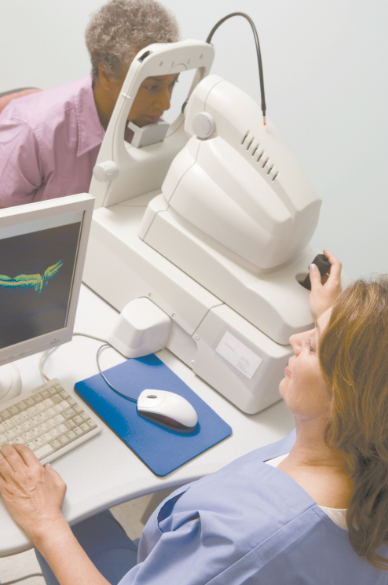
In a comprehensive dilated eye exam, an eye care professional uses several techniques to detect the signs of glaucoma. Eye drops are used to dilate, or widen, the pupils, allowing the doctor to check for damage to the optic nerve. Eye pressure is measured by blowing a quick puff of air into the eye or applying a pressure-sensitive tip near or against the eye. The doctor may also apply numbing drops when measuring eye pressure. Side or peripheral vision is measured with a visual field test.
Medicare offers eye care assistance to people at greatest risk for glaucoma. People with Medicare coverage who are African Americans aged 50 or older, are Hispanic/Latino Americans aged 65 and older, have diabetes, or have a family history of glaucoma may be eligible for a low-cost, comprehensive dilated eye exam. Call 1–800–MEDICARE or visit http://www.medicare.gov to learn about the benefit. Information about other possible financial assistance to cover eye care is also available at http://www.nei.nih.gov/health/financialaid.asp.
Having vision is essential this time of year as we set resolutions regarding all we hope to accomplish over the next twelve months. As we commit ourselves to positive life changes this year, let’s also remember to do all we can to preserve our actual vision.
