
DON’T SHOOT THE MESSENGER: LISTEN TO THE MESSAGE
Django Unchained is a Freedom Journey
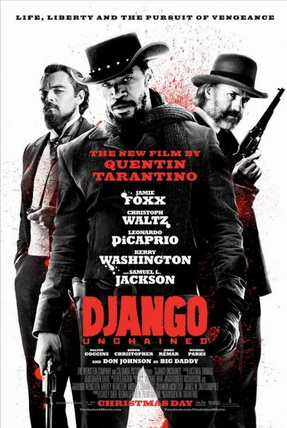
Movie Poster from wikipedia.com
By: Tawnya Pettiford-Wates, Ph.D.
Quentin Tarantino made a movie and the primary goal for him was to make it entertaining enough to sell tickets. By box office reports since DJANGO Unchained opened on Christmas Day, he has accomplished that goal with the film coming in 2nd to Les Miserables @ 15.5 million & 17.5 million respectively. DJANGO is on track to recoup its 100 million dollar production budget in short order.
Most “slave stories” produced by Hollywood (there are a few) are based on victimology (the slave as the victim) and/or the white savior narrative, the “birth of a white consciousness” refrain we hear so often repeated in storyline after storyline. The story of the slave and the slave’s journey becomes background, a canvas on which to paint the white savior/ leader drama and the slave becomes the black sidekick or co-star. Not this time. DJANGO Unchained is a Hero’s Journey and the hero is black. This is not what we are accustomed to seeing on the big screen as a major motion picture release from a major motion picture studio like Columbia Pictures. No. On the contrary, there are a slew of major releases from white studios and producers that glorify the “white savior”/black co-star narrative and continue the theme of black folks redeeming white folks like; Mississippi Burning, Driving Miss Daisy, Cry Freedom, Grand Canyon, Monster’s Ball and most recently The Help just to name a few.
Tarantino teamed up with Reggie Hudlin, co-producer of DJANGO and formerly president of entertainment for BET Network. Hudlin, talented producer/director, began producing films in 1992 with the release of Bebe’s Kids, and later House Party, Boomerang and Ladies Man. Tarantino and Hudlin began talks about a slave film over 15 years ago. Tarantino says of Hudlin “You planted the seeds and now here’s the tree.” And Django Unchained appears to be a mighty oak.
Taking the story of DJANGO and placing it on the backdrop of the western frontier was a brilliant creative stroke as audiences are not used to contextualizing slavery in any other way geographically than the antebellum south. In this alternate context, Tarantino has already taken the audience outside of their comfort zone. Using the fantasy-revenge model and peppering it with humor in classic Tarantino fashion allows the audience to go on a journey of epic proportion and actually root for the hero of the story, DJANGO (the d is silent.)
After seeing DJANGO: unchained, to my complete surprise, I actually enjoyed the film. Quentin Tarantino is NOT one of my favorite film makers and I do have serious concerns about the way he has historically approached and exploited women, Asian cultural & spiritual practices and people of African decent in his films, not to mention gratuitous violence, clumsy use of language (including too many MFs, Bs, and f-ing this, that & the other.) Suffice to say, I generally do not like his films with the exception of Kill Bill Vol 1 & 2 for many of the same reasons I enjoyed DJANGO.
Quentin Tarantino is a filmmaker who works within a certain style & genre not unlike Spike Lee, who has expressed a vehement dislike of the film and Tarantino’s use of the N-word. Lee plans to boycott the film, which I find unfortunate. But that is another article indeed. Though Tarantino is dealing with historic truths, such as the brutality and horrific inhumanity of chattel slavery, he has made a film and created a character that in many respects is “larger than life.”
DJANGO is a character of fiction and as such he does some unbelievable and fantastical things. The villains likewise are largely drawn and one-dimensional. However, the root of their villainy is certainly based in TRUTH. There was NO redeeming value to the institution of slavery unless you want to qualify the building of White American wealth and the creation of institutional white supremacy as a part of what was redemptive about the institutional enslavement of African people in America. No. This film magnifies the heinous brutality of human kind through the journey of the character DJANGO (a super hero.) He is a super hero, a bonafide Black Super Hero who makes the act of revenge both heroic and redemptive. I LOVED that about the film. This was Django’s story. It was NOT the white savior model that we ALL have become so accustomed to seeing from Hollywood. In this film, there were good guys & bad guys, both black & white. There were people used as props, both black & white. And the White woman was certainly NOT the standard for anything beautiful or redemptive. We are certainly NOT accustomed to seeing that!
Django is intelligent, resourceful and is ultimately the SOLE HERO in this film. I ENJOYED that! I REALLY enjoyed that. Again, the woman must be saved and yes the N-word is used excessively. But certainly NOT more excessively than it would have been used in pre Civil War Texas, Mississippi or Virginia for that matter. That was REAL! And finally someone BLEW UP uncle tom (see the movie). This film will come to be studied in the future and I believe it will even become a “classic” in time. As much as I dislike Tarantino as a filmmaker at times…this film was well done! Well DONE. The critical discourse and dialogue it is generating makes me exceedingly happy.
DJANGO Unchained is an adult film. Taking young children or youth is not recommended and many adults will be challenged by the violence, language and perhaps your personal knowledge of history.
Tawnya Pettiford-Wates, Ph.D.
Founder & Artistic Director
The Conciliation Project
& VCU Professor of Theatre
www.theconciliationproject.org

1 comment
[…] Many of our readers will remember the feature that Urban Views published in July 2011 on The Conciliation Project where she used theatre to discuss racism. And just last week she wrote a review on Django Unchained. […]
Comments are closed.