

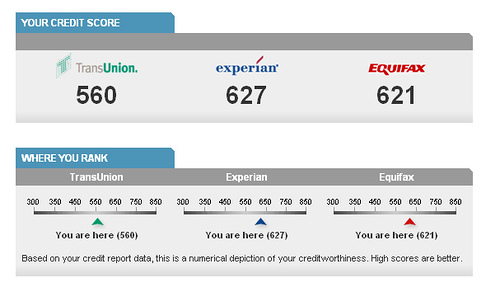
Sample credit report
By Jason Alderman
If you’ve ever tried to remove inaccurate or fraudulent information from your credit report and gotten the runaround, take heart: The Consumer Financial Protection Bureau is now on the case.
In July 2012, the watchdog agency, formed as a result of the Dodd-Frank Wall Street Reform and Consumer Protection Act of 2010, gained authority to supervise all of the major consumer reporting agencies.
The CFPB now advocates for consumers who have complaints regarding interactions with credit bureaus and identity theft protection services. This adds to the agency’s consumer grievance oversight which already included mortgages, bank accounts, consumer loans and private student loans.
“Credit reporting companies exert great influence over the lives of consumers,” said CFPB Director Richard Cordray in announcing his agency’s new responsibility. “They help determine eligibility for loans, housing, and sometimes jobs. Consumers need an avenue of recourse when they feel they have been wronged.”
You can seek assistance from the CFPB if you have issues with:
- Incorrect information on your credit report;
- How a consumer reporting agency is handling its investigation of your complaint;
- The improper use of a credit report;
- Being unable to get a copy of a credit score or file; and
- Problems with credit monitoring or identity-protection services.
Here’s how the new system works:
If you believe your credit report contains incorrect or fraudulent information, you should first file a dispute with and get a response directly from that credit reporting company before contacting the CFPB. The same goes if you have an issue with how the company is handling its investigation of your grievance – for example, if they don’t respond in writing within 30 days.
If, after filing your grievance, you are dissatisfied with the resolution, you may file a complaint with the CFPB using any of the following methods:
- File online at www.cfpb.gov/complaint
- Call toll-free at 855-411-2372
- Fax it to 855-237-2392
- Mail to Consumer Financial Protection Bureau, P.O. Box 4503, Iowa City, Iowa, 52244.
Once your complaint has been logged, you’ll be given a tracking number to check its status. Each complaint will be processed individually and sent to the credit bureau in question for response. The CFPB expects companies to respond within 15 days with information about the steps they have taken or plan to take. You’ll have the option to dispute the company’s response to your complaint.
Credit reporting companies issue more than 3 billion consumer credit reports a year and maintain files on more than 200 million Americans. Among other things, they track the number and types of credit accounts you use, how long they’ve been open and whether you’ve paid your bills on time.
“The consequences of errors in a consumer report can be catastrophic for a consumer, shutting him or her out of credit markets, jeopardizing employment prospects, or significantly increasing the cost of housing,” noted the CFPB’s announcement.
You can order one free credit report per year from the three major credit bureaus – Equifax, Experian and TransUnion. (Order through www.annualcreditreport.com; otherwise you’ll pay a small fee.) Proactively ordering your reports on a regular basis can help identify bad credit behavior and spot fraudulent activity or errors before they can damage your credit.
To learn more about credit reports and scores, visit the CFPB’s website, www.cfpb.gov. Another good resource is What’s My Score (www.whatsmyscore.org), a financial literacy program run by Visa Inc.
Jason Alderman directs Visa’s financial education programs. To Follow Jason Alderman on Twitter: www.twitter.com/PracticalMoney.

1 comment
I appreciate that you did not moniten the brand name of a preserved fruit package you dumped into a garbage can. I would like to share a true story happened here in the U.S. seven years ago. A woman, named Ayala, claimed that she bought a bowl of chili soup from a famous Wendy Restaurant and found a finger in it and accidently bit into it. The news got media attention and was covered by all media outlets throughout the nation. Both prosecutors who handled the case and Wendy own investigators launched the case to determine whether the claim was valid. Later investigators found out that it was a scheme to extort money from a fast-food chain restaurant. The Wendy Restaurant Chain also announced that they lost $21 million in lost sale due to the firestorm. The justice system in the U.S. is well structured and organized to seek the protection of its own people. There are many branches: Crime Lab Investigation Unit, FBI database access, and Medical Examiner Office, supporting to the justice system that investigated the case thoroughly. It is a way of practicing check and balance as monitened in your post. As we all know that the justice system in Myanmar has broken since 1962. I am not sure we have consumer rights in Myanmar. It may be or it may have never been existed. Simply consumer rights are given to consumers for their safety and satisfaction. However consumers must and should know how to exercise their rights in an honest and sincere way. If someone like Ayala claims that he/she finds hair or bugs or bird poop in his/her food, can our justice system in Myanmar solve it effectively and efficiently? My question here is what if the rights are given to wrong people. I am just thinking one step further. This is just food for thought. It is also fair for both the claimer and the business entrepreneurs and small business owners.
Comments are closed.