

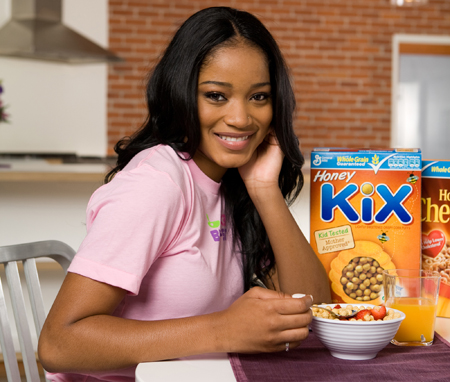
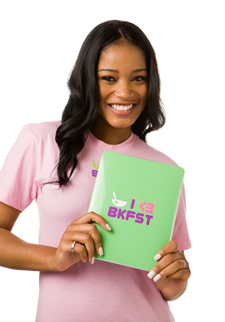
Keke Palmer, the teen actress and singer who stars in the Nickelodeon sitcom True Jackson, VP, invites teen girls ages 14 to 17 to commit to eating breakfast – and to helping other girls. Keke is spokesperson for I<3BKFST, translated as I HEART BREAKFAST, a campaign with General Mills designed to help educate teens and their parents and guardians. It borrows its name from the popular text symbol for love “<3.” Teens can visit Facebook.com/IHEARTBKFST, where they can first “like” the IHEARTBKFST page, and then pledge to eat breakfast. In turn, General Mills will donate $0.25 for every pledge made through Dec. 22 – up to $10,000 and a minimum donation of $5,000 – to Grace House, a foster home for girls in need located in Birmingham, AL.
“About half, or approximately 51 percent, of girls followed in the study were African-American, so there is a real purpose for reaching out directly to teen Black girls to help them understand the benefits that come with having breakfast,” explained KeKe. “Starting the day right with a bowl of cereal topped with fruit, milk and a glass of orange juice is a smart choice—and one that more girls need to make. I’m asking girls to pledge on Facebook to eat breakfast—so they can help themselves and someone in need, too.”
Breakfast Boosts Health
The pathway to better health for teenage girls starts with the first meal of the day, and when they make a “good-for-me” choice their odds of having a healthier body weight and lower cholesterol improve. These are the latest peer-reviewed findings summarized in Public Health Nutrition. This analysis of the National Heart Lung and Blood Institute Growth and Health Study (NGHS) data was funded in part by the General Mills Bell Institute of Health and Nutrition. The NGHS followed the diets of 2,379 girls who, at the beginning of the study, were between the ages of nine and 10 from 1987 to 1997; 51 percent, or 1,213, were African American girls and 1,166 were Caucasian girls who lived in Berkley, CA, Cincinnati, OH and Washington, D.C.
Based on analysis of the girls’ food diaries, breakfast cereal eaters tended to have lower waist-to-height ratios, which is an indicator of healthy body weight, lower total cholesterol and lower LDL cholesterol. Previous findings from NGHS cited health benefits of eating breakfast related to lower BMI (findings released in 2005) and improved nutrition, higher milk consumption and increased physical activity (findings released in 2008).
One of the healthiest breakfast choices in the 10-year study was fortified ready-to-eat cereal, which helped boost the nutrient content in the girls’ diets. Analyses of the study results identified that tween and teen girls who regularly ate cereal for breakfast – relative to 24 other reported breakfast foods – were less likely to be overweight, had healthier body weights and lower cholesterol. A recent report indicates that 24 percent of African American girls ages 12 to 17 are overweight, compared to 15 percent of white girls .
“As we look at the results of the study, it’s important to communicate three primary points with girls and their parents or guardians,” explained Susan Crockett, PhD., RD, F.A.D.A., Vice President and Senior Technology Officer, Bell Institute of Health and Nutrition. “First, breakfast is a must for better health. Second, choose foods that will nourish your body and help jumpstart your day. Third, fortified cereal is a convenient, wholesome choice.”
“Encouraging healthier eating habits is every parent’s responsibility, and given the body of evidence supporting the benefits of breakfast – and breakfast cereal as a good choice – we’re clearly giving our girls a great advantage by reinforcing the importance of the first meal of the day,” said Karol Watson, vice president, Association of Black Cardiologists and I <3 BKFST spokeswoman.
