
Virginia Residents Discuss What Constitutes America
by Cesca Janece Waterfield
Constitution Week begins each year on September 17, the day the U.S. Constitution was signed in 1787. It commemorates the adoption of the Constitution, which established the framework for the U.S government. Officially enacted in August 1956 by President Eisenhower, Constitution Week runs to Sep. 23.
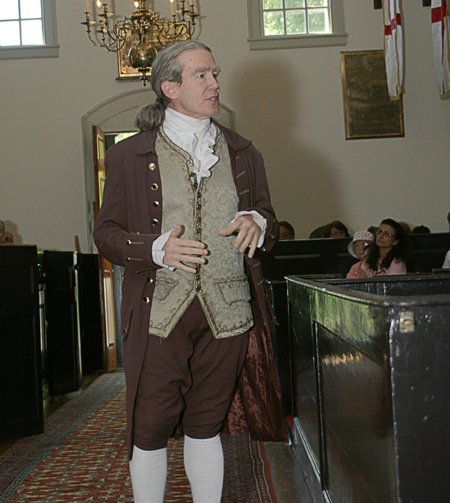
A Local Critic?
Patrick Henry was a politician, lawyer, and speaker born in Hanover County in 1736. He served twice as the governor of Virginia and advocated strongly for the American Revolution, delivering the famous “Give me Liberty or give me Death!” speech at St. John’s Church in Richmond. But when the U.S. Constitution was being discussed in 1787, he opposed it, believing that it didn’t support the rights of individuals enough. The points of the Constitution would be debated for months before it was adopted. The final document reflects the statesmanship, careful thought and compromise of many individuals.
 A Richmond Scholar’s View
Dr. Henry L. Chambers, Jr. is Professor of Law at University of Richmond. A graduate of University of Virginia School of Law, Dr. Chambers has published articles and essays on a vast area of topics including discrimination, sexual harassment, voting rights, and the connection between constitutional and biblical interpretation. He lectures on constitutional law principles for the Center for Civic Education.
The Constitution has two faces. The Constitution is our majestic civil Bible and our pedestrian rulebook. The Constitution literally constitutes us. It reflects who we are, but also who we hope to be. At the same time, the Constitution gives us quite ordinary and sometimes unnecessary rules for governing the country. It is the founding document of the nation that, at its inception and without its Bill of Rights, explained merely how the federal government was to relate to state governments. The Preamble gives a glimpse of the Constitution’s dual nature. The Preamble provides what can be interpreted either as stirring rhetoric that gives us the great purpose for our country or as a simple explanation of why combining the thirteen states into the United States is a good and strategic move for all residents of the states.
Few, if any, would argue that the Constitution is or has ever been perfect. Its original acceptance of slavery guarantees that. However, its amendment and expansion demonstrates its growth and our growth. It has morphed from its original role as an explanation of the relative roles of the federal and state governments into an expression of how the citizenry and government will interact for the betterment of both. Its metamorphosis is a reminder that we are working to make a more perfect union. We may never create a perfect union, but the Constitution may help us move in that direction.
The Constitution binds us together as a nation and as a people, if imperfectly. It commands our respect and at some times our love and devotion. At times, it has been unworthy of the equality it claims to provide. At other times, it has been the most powerful document for equality the world has seen. As long as we have a United States, we will have a Constitution of the United States. Even if we do not fully embrace all of its words or fully agree on how it is to be interpreted, the Constitution is the one supreme document that we can agree that governs us all as inhabitants of the United States. Whether it is amended, improved or expanded, it should and must endure.
