

by Ronny Marie Tucker
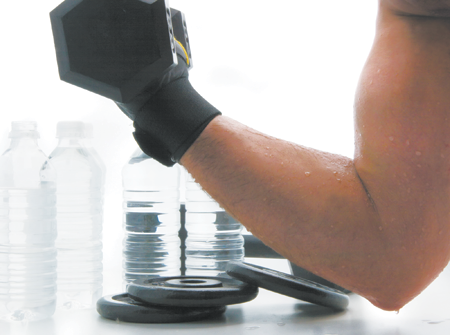
Burn calories and build muscle with this “do-it-yourself” fitness plan. With or without weights, indoor or outdoor, design a plan that suits your needs. Constantly change your routine to avoid boredom or a plateau, when you stop seeing results. For instance, if you use the treadmill, try the track. Typically work out in the morning? Try the evening instead. There is always something to do differently that will affect your training in the end. Never let your bodies get lazy!
Choose Your Days >>>
Determine how many days per week you want, or need, to work out. The American College of Sports Medicine (ACSM) recommends three to five days of physical activity. If you currently live a sedentary lifestyle, start out with three days per week and work your way up to five. Adding two to three days of resistance training per week will maximize conditioning as well as weight loss. Whenever possible, work out on nonconsecutive days such as Monday, Wednesday and Friday. A day off between workouts allows time for the body to rest, repair and recover.
Decide How Long >>>
The ACSM recommends 20 to 60 minutes of physical activity per day. However, 60 to 90 minutes of physical activity may be necessary to achieve or maintain weight loss. Divide your workout time into smaller increments if necessary. For example, complete 20 minutes of exercise in the morning, 20 minutes around noon and 20 minutes in the evening.
Pick Your Type >>>
Cardiovascular exercise and resistance training are the main components of any exercise plan. Cardiovascular exercise such as walking, swimming, dancing, running, skating or cycling will burn many calories as well as strengthen your respiratory system—heart and lungs. Choosing an activity you enjoy makes it easier to perform for longer periods of time—improving fitness and burning more calories. Resistance training can be done with weights, resistance bands, medicine balls, weight machines or any object that can act as a weight—soup cans or milk jugs. Calisthenics, such as push-ups, pull-ups, sit-ups or lunges, are also a form of resistance training that can be done anywhere at any time.
Go For It! >>>
For weight loss or health improvements, keep an intensity level of at least 55 percent of your maximum heart rate. Training for a specific sport or high-intensity activity may require more than 75 percent. For an estimate of your maximum heart rate, subtract your age from 220. You can also gauge your intensity level by using the Rate of Perceived Exertion (RPE)—on a scale of one to ten, how do you feel? For weight loss and general fitness goals, you should feel between five and seven—working enough to feel the effects but not so hard you can hardly breathe. Cardiovascular fitness, or training for a sport, may require high intensity workouts more often. For example, a soccer player isn’t training to lose weight. He trains to keep his fitness and intensity level high as if he were in a game.
Contact Ronny at ronny-marie@urbanviewsweekly.com
