
by Y.B. Thompson
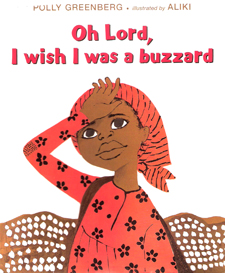 On a recent cold evening at bedtime, I came upon my daily pleasure of sitting down with my two year old daughter to read a story. Nighttime reading is a ritual for us, a literary night cap that makes my baby’s disappointment about ending the day and falling into slumber a little more tolerable. Because my daughter is part of a wonderful preschool that also fosters reading, we had a new book to add to our fold, one that the school had been reading to her in the classroom, entitled Oh Lord, I Wish I Was a Buzzard, by Polly Greenberg.
As I gathered her in my arms and slid back on our red reading recliner, I added a comforting bounce to my embrace. I had no idea what a bumpy ride that evening’s choice reading would take me for.
The protagonist of the tale is a little girl who is working with her family on a hot day, all the while constantly wishing to be another element of nature that surrounds her—a dog sitting leisurely under a tree, a snake coiled in the cool shade, the title buzzard flipping its wings away in the wind. When she and her family complete their work day, the little girl earns the treat she has worked for all day—a lollipop.
So what could be wrong with this story? On its face, this story relays the positives of having a good work ethic: If you work diligently, you will be handsomely rewarded, in this instance, with every child’s delight, a piece of candy. Ideally, it imparts the example of family bond, as the little girl works along side her father, mother and brother on a common goal. That lesson is an important tool for now and the future, as it teaches my little girl that it is important to play your part in the family unit and to support one another.
Here’s where the controversy kicks in: Our little protagonist is part of a sharecropper family. The first page of the story introduces her picking cotton. The pages that follow show her family and other black folks also bent in rolling hills of cotton, collection baskets in tow. With each page, she adds a sing-song rhyme to the task at hand.
Sure, her toils are wrapped in cute language and the story sets out on the intention of imparting positive lessons. But my future She-ro is witnessing a little one working in cotton fields, in the hot sun, wishing to be a cold-blooded snake or a scavenger, with the compensation of a lollipop after hours of indentured servitude.
Who would think that reading time with a two year old could be so wrangled in the complicated politics of culture and race?
Where do I even begin in terms of tackling why this book is not the book for my little girl, much less any of her two year old classmates? Do I start at the historical significance? The way race plays into this act and whole scenario? As it stands, my daughter has no concept of race, and thus none of the drama that comes with racial politics. I absolutely want to teach my daughter our slave story, but I wanted to be the one to choose the timing on when to expose her to that part of our history. I had planned for it to be at a time when we could sit and discuss it as a family, so that we could put it in its proper context. I wanted her to read all the major titles—Narrative of the Life of Frederick Douglas; Incidents in the Life of A Slave Girl; The Interesting Narrative of the Life of Olaudah Equiano—and then afterwards, to reflect on her outlook on the world and her place in it.
Instead, my daughter got her first introduction to heavy, context-filled history in a simple, mainly picture-driven children’s book. My daughter saw a reflection of her beautiful black self in rags and a head tie. I am not quite sure what to do with that.
In rearing my daughter, I have allied myself with the progressive trends of my great north migration kinfolk, who sought to transcend race, to build on their lives and prove their worth through intellect and hard work, and in turn be treated with dignity, respect and humanity. Both in the futuristic advances of tomorrow and the characteristic cultural limitations of today, I am seeking to first build up my girl through the stories of powerful, strong-voiced examples of Oprah Winfrey, Toni Morrison, Tyra Banks and other such women who did not have to don kerchiefs to tell our story and know success.
This image of the enslaved black woman or man is all too often our immediate go-to in talking about black history. While these are important images certainly worthy of honor and reflection, for the sake of imparting the breadth and depth of our story, of fortifying our girls and boys with the facts they need to be well-educated and inspired to advance our race and this country, we have to freshen up our delivery. We must give the stories of local community leaders, of young and older civic leaders like Barbara Lee, Stephanie Tubbs Jones, Maxine Waters, Cory Booker and Deval Patrick; of black CEOs, doctors, thinkers and artists, not only to show our story, but also to be certain that they know that this country is theirs, that countless opportunities await them, and that we have been more than slaves. We have been survivors and achievers.
Y.B. Thompson is a freelance writer living in Richmond. Her work has appeared in The Washington Post, Rolling Out, District Chronicles and other publications.
