

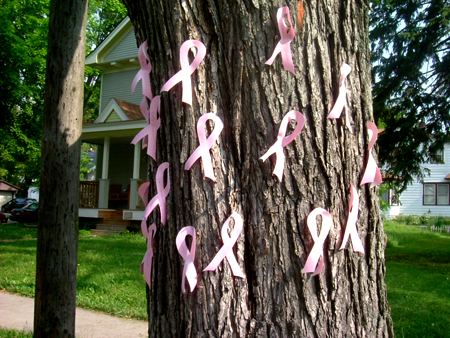
Get informed during the month of October, which is designated Breast Cancer Awareness Month.
What are the chances that a woman in the United States might get breast cancer?
Age is the most significant risk factor for breast cancer. The older a woman is, the greater her chance of developing breast cancer. Based on population averages, rates suggest that 13.2 percent of women (or one in eight) born today will be diagnosed with breast cancer at some time in their lives. Most breast cancers occur in women over the age of 50. The number of cases is especially high for women over age 60. Breast cancer is relatively uncommon in women under age 40.
What is the best method of detecting breast cancer as early as possible?
Getting a high-quality mammogram and having breast exam done by a health care provider on a regular basis are the most effective ways to detect breast cancer early. Like any test, mammograms have both benefits and limitations. For example, some cancers cannot be detected by a mammogram, but may be found by breast examination.
Checking one’s own breasts for lumps or other unusual changes is called breast self-exam (BSE). Studies so far have not shown that BSE alone reduces the number of deaths from breast cancer. BSE should not take the place of routine clinical breast exams and mammograms.
Where can women get high-quality mammograms?
Women can get high quality mammograms in breast clinics, hospital radiology departments, mobile vans, private radiology offices, and doctors’ offices.
Women can ask their doctors or staff at the mammography facility about FDA certification before making an appointment. All mammography facilities are required to display their FDA certificate. Women should look for the MQSA certificate at the mammography facility and check its expiration date. MQSA regulations also require mammography facilities to give patients an easy-to-read report on the results of their mammogram.
Information about local FDA-certified mammography facilities is available through the CIS at 1–800–4–CANCER (1–800–422–6237).
What is a screening mammogram?
A screening mammogram is an x-ray of the breast used to detect breast changes in women who have no signs or symptoms of breast cancer. It usually involves two x-rays of each breast. Mammograms make it possible to detect tumors that cannot be felt. Mammograms can also find tiny deposits of calcium in the breast that sometimes indicate the presence of breast cancer.
What are the benefits of screening mammograms?
Several large studies conducted around the world show that breast cancer screening with mammograms reduces the number of deaths from breast cancer for women ages 40 to 69, especially those over age 50.
How are screening and diagnostic mammograms different?
A diagnostic mammogram is an x-ray of the breast that is used to check for breast cancer after a lump or other sign or symptom of breast cancer has been found. A diagnostic mammogram also may be used to evaluate changes found during a screening mammogram, or to view breast tissue when it is difficult to obtain a screening mammogram because of special circumstances, such as the presence of breast implants. A diagnostic mammogram takes longer than a screening mammogram because it involves more x-rays in order to obtain views of the breast from several angles. The technician may magnify a suspicious area to produce a detailed picture that can help the doctor make an accurate diagnosis.
When does the National Cancer Institute recommend that women have screening mammograms?
Women age 40 and older should have mammograms every 1 to 2 years.
Women who are at higher than average risk of breast cancer should talk with their health care providers about whether to have mammograms before age 40 and how often to have them.
What does the American Cancer Institute recommend?
Women 40 years of age and older should have a screening mammogram every year.
How much does a mammogram cost?
Screening mammograms generally cost between $50 and $150. Most states now have laws requiring health insurance companies to reimburse all or part of the cost of screening mammograms. Insurance companies and health care providers can supply details.
All women age 40 and older with Medicare can get a screening mammogram each year. Medicare will also pay for one baseline mammogram for a woman between the ages of 35 and 39. There is no deductible requirement for this benefit, but Medicare beneficiaries have to pay 20 percent of the Medicare-approved amount. Information about Medicare coverage is available at www.Medicare.gov on the Internet, or through the Medicare Hotline at 1–800–633–4227 (1–800–MEDICARE). For the hearing impaired, the telephone number is 1–877–486–2048.
Some state and local health programs and employers provide mammograms free or at low cost. For example, the Centers for Disease Control and Prevention (CDC) coordinates the National Breast and Cervical Cancer Early Detection Program. This program provides screening services, including clinical breast exams and mammograms, to low-income women throughout the United States and in several U.S. territories.
Contact information for local programs is available by calling the CDC at 1–800–CDC–INFO (1–800–232–4636). Information on low-cost or free mammography screening programs is also available through the NCI’s Cancer Information Service (CIS) at 1–800–4–CANCER (1–800–422–6237).
Information provided by National Cancer Institute and the U.S. National Institutes of Health. www.Cancer.gov. Used with permission.
