
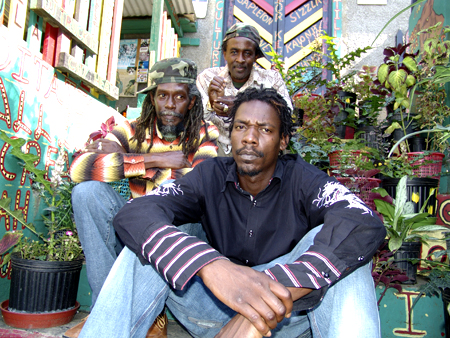
On Sep. 6, Culture, Jamaica’s legendary traditional reggae band, will perform at Toad’s Place. The tour is an exciting if poignant milestone in Culture’s thirty-plus year career. Founding member, Joseph Hill, died in 2006 while the band was on tour in Germany. Saturday’s performance will introduce Richmond to his son, Kenyatta, who stepped forward after his father’s death to lead the iconic band. Kenyatta, who had worked as the band’s audio engineer, has stunned and impressed critics and fans alike with a haunting vocal likeness to his father. Richmond’s show is particularly unique in that it takes place nearly two years to the day of the memorial service for the late, great Joseph Hill, who was laid to rest in Kingston, Jamaica on Sep. 9, 2006.
Joseph Hill & the African Disciples
In the late ’60’s in the Linstead area of Jamaica, Joseph Hill played percussion and often sang with a group called the Soul Defenders. In 1976, Albert Walker approached Joseph about starting their own band. With Kenneth Dayes, they formed the African Disciples, with Hill as lead singer, and Dayes and Walker on harmonies. They entered the studio and took up the name “Culture.” Their first single was recorded with Joe Gibbs and was called “This Time.” Culture had a series of hits following, and in 1977, recorded their debut album, “Two Sevens Clash.”
World Fame with “Two Sevens Clash”
The title came from a Marcus Garvey prediction that there would be widespread turmoil on July 7, 1977 when the “sevens clashed.” The album was a tremendous success in Jamaica and Britain. It was named Reggae Album of the Year by Rolling Stone Magazine in 1977. Culture began playing live shows in New York City and recorded “Africa Stand Alone.” Over the next three years, they recorded three albums, “Harder than the Rest,” “Cumbolo,” and “International Herb.”
In 1983, the group split, and Hill began working on a solo career. He recorded an album with his old band the Soul Defenders, and they went on tour. Meanwhile, Walker and Dayes recorded a few songs for Henry “Junjo” Lawes. But as a band, Culture did nothing together for three years.
Culture Like Never Before
Then in ’86, the trio reunited the original lineup and got straight to work. They toured constantly and recorded six albums. In ’93, after the most dynamic period of their career. Kenneth Dayes left to pursue a solo career. Culture recruited the lead singer of Dub Mystic to be their second harmony singer.
For the next six years, Culture continued world tours and released their first live album, “Cultural Livity.” In 1999, Hill and Walker invited Jamaican singer Telford Nelson to join, and teamed with a new backing band, who eventually took the name Forces of Justice.
In 2002, “Two Sevens Clash” was named one of the “50 Coolest Records of All Time” by Rolling Stone Magazine. It was the only reggae album to make the list. That year, the band released a live album and DVD, both named “Live in Africa.” The group signed and recorded “World Peace” with their new label, Heartbeat Records and continued to tour with the Forces of Justice band. In 2004, Joseph was inducted into the Jamaican Reggae Walk of Fame. The following year, Joseph, a devout Rastafarian, was honored by Jamaica’s Prime Minister.
While touring Germany in the summer of 2006, Joseph became ill and died at the age of 57. With his son Kenyatta at Culture’s helm, the band may embark upon another era in their celebrated career.
Culture featuring Kenyatta Hill performs at Toad’s Place with Richmond’s Antero, Sat., Sep. 6. The show is all ages, $15 at the door.
by Cesca Janece Waterfield
